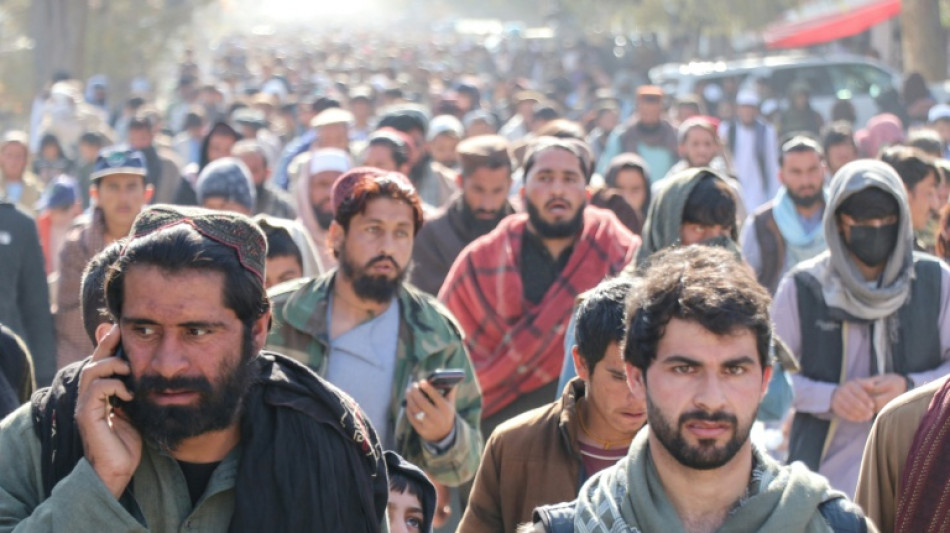
Afghan Taliban authorities publicly execute man for murder / Photo: - - AFP

A man convicted of murder was publicly executed at a stadium in eastern Afghanistan, witnesses told AFP on Tuesday, a punishment a UN rights monitor called "inhumane".
The man is the 12th person publicly executed since the Taliban returned to power in 2021, according to an AFP tally.
The man, identified as Mangal, was executed in front of a crowd in Khost, the Supreme Court said in a statement.
Witnesses told AFP the man was shot three times by a relative of the victim, in a scene witnessed by thousands of people.
He had been sentenced to "retaliatory punishment" for killing a man after his case was "examined very precisely and repeatedly", the court said.
"The families of the victims were offered amnesty and peace, but they refused," it said.
These executions could "prove to be positive" because "no one will dare to kill anyone in the future", said Mujib Rahman Rahmani, a Khost resident at the stadium.
Authorities had urged people to attend the execution in official notices shared widely on Monday.
They said he was one of several attackers who opened fire on a house in January 2025, killing 10 people, including three women.
The UN Special Rapporteur on Human Rights in Afghanistan, Richard Bennett, said Tuesday before the public execution that such acts were "inhumane, cruel, and an unusual punishment, contrary to international law."
"They must stop," he wrote on social media.
- International outcry -
Public executions were common during the Taliban's first rule from 1996 to 2001, with most of them carried out in sports stadiums.
The previous execution -- the 11th according to AFP's tally -- took place in October, when a man was put to death in Badghis in front of thousands of spectators, including Taliban officials.
Before that, four men were put to death in three different provinces on the same day in April.
Taliban authorities also continue to employ corporal punishment, mainly flogging, for offences including theft, adultery and alcohol consumption.
All execution orders are signed by the Taliban's reclusive supreme leader Hibatullah Akhundzada, who lives in the movement's heartland of Kandahar.
Law and order are central to the Taliban's ideology, which emerged from the chaos of a civil war following the withdrawal of Soviet forces from Afghanistan in 1989.
Rights groups such as Amnesty International have also denounced the Taliban government's use of corporal and capital punishment.
In its annual report published in April, Amnesty said Afghanistan was among the countries where death sentences were imposed after trials that "did not meet international fair trial standards".
喬-H.Qiáo--THT-士蔑報