Polish doctors jailed for denying woman abortion / Photo: Wojtek Radwanski - AFP

A Polish court on Tuesday sentenced three doctors to prison sentences over the 2021 death of a pregnant woman, which sparked nationwide protests and renewed scrutiny of the country's restrictive abortion laws.
The woman, Izabela, whose last name has not been made public, died of sepsis in 2021 while experiencing complications in the 22nd week of pregnancy.
Her death came a year after a law toughening abortion restrictions in the mainly Catholic country came into effect and reignited mass protests.
The three doctors were charged with directly endangering Izabela's life.
A regional court in Katowice sentenced one, who was also charged with causing involuntary manslaughter, to 18 months in prison and barred him from practicing medicine for six years.
A second was sentenced to 15 months behind bars and barred from practicing for six years. The third doctor was given a one-year jail term and barred from practicing for four years.
"It's an appropriate, fair punishment," Karolina Kolary, a laywer for Izabela's family, told journalists after the closed-door hearing.
"This was a case involving extraordinary negligence, a pure disregard for the most basic and fundamental medical duties," she added.
Abortion in Poland is legal only in two circumstances: when the pregnancy resulted from a criminal act -- such as rape or incest -- or if it threatens the mother's life or health.
- Septic shock -
Several pregnant women have died in Polish hospitals in recent years, in many cases after doctors refused to carry out abortions.
Izabela, 30, was at a hospital in Pszczyna, in southern Poland, after her amniotic fluid broke. The woman and the doctors were aware of defects affecting her foetus, but the termination of her pregnancy was delayed.
Less than 24 hours later, Izabela died of septic shock. She left behind a young daughter from a previous pregnancy.
According to Izabela's family, doctors waited for her foetus to die before acting, fearing legal consequences.
The hospital said the decisions of medical staff were based on concerns for the health of both mother and foetus.
- 'Not one more' -
Izabela's death was the first case linked to a 2020 decision by the Constitutional Tribunal, which ruled that severe foetal abnormalities were not legal grounds for abortion.
Prior to this ruling, 98 percent of legal abortions in Poland were performed for this reason.
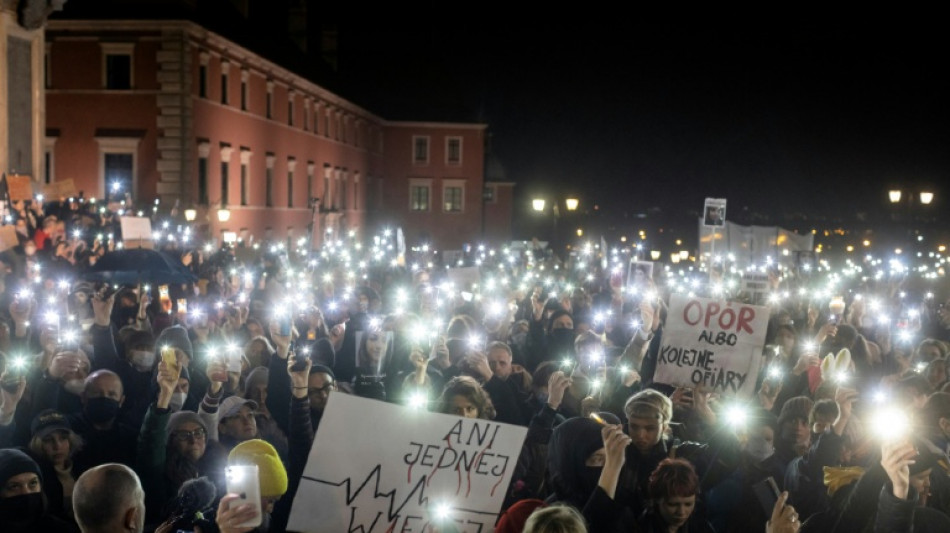
The new restrictions set off a torrent of protests throughout the country, which became the largest mass demonstrations in Poland since the 1989 anti-communist movement.
After Izabela died, nationwide protests broke out again, this time under the slogan "Not One More".
On top of the charges against the doctors, Poland's National Health Fund (NFZ) found numerous irregularities in Izabela's care and fined the hospital 650,000 Polish zloty ($179,000).
The Polish patients' rights ombudsman also found that Izabela's rights had been violated, and recommended new protocols for septic shock and for situations posing threats to a woman's health.
- Politics -
Poland's centrist ruling coalition promised to reverse the most restrictive elements of Poland's abortion laws before their election in 2023 -- but internal disagreements among its different factions have halted this.
Any attempt by parliament to ease the abortion laws would likely face a veto by President Karol Nawrocki, a conservative-nationalist who was endorsed by the Law and Justice (PiS) party that brought about the 2020 court ruling.
Poland has one of the most restrictive abortion laws in Europe.
In the first half of 2025, only 411 legal abortions took place, according to the NFZ.
"Izabela was not the first or last woman in Poland to die for lack of a safe abortion," Mara Clarke, co-founder of the NGO Supporting Abortions for Everyone (SAFE), told AFP.
"I pray there are no more dead women in future," she added.
Lawyers for the doctors said they would appeal to the Supreme Court.
馬-J.Mǎ--THT-士蔑報