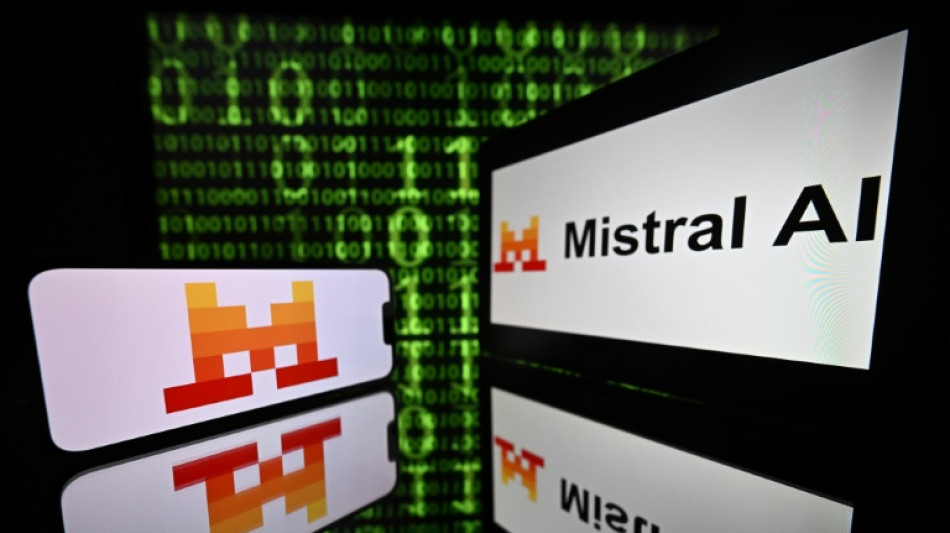
Mistral chief calls for European AI levy to pay creatives / Photo: Lionel BONAVENTURE - AFP/File

Companies selling artificial intelligence models in Europe should pay a "levy" to support cultural industries, the head of French developer Mistral said Friday.
AI models are trained on vast swathes of human-generated data including text, audio and video, which has prompted complaints and legal challenges to their developers from both creators and copyright-owning companies in America and Europe.
Operators of AI models in Europe should pay "a revenue-based levy... reflecting their use of content publicly available online," Mensch wrote in an op-ed for the Financial Times (FT) shared with AFP.
"Proceeds would flow into a central European fund dedicated to investing in new content creation, and supporting Europe's cultural sectors," he added.
Mistral's external affairs chief Audrey Herblin-Stoop told AFP that the company was suggesting a levy of between 1.0 and 1.5 percent of revenues.
With most major AI developers based in the US, Mensch insisted that "this levy would apply equally to providers based abroad, creating a level playing field within the European market and ensuring that foreign AI companies also contribute when they operate here".
Brussels' AI regulation, adopted in 2024, requires systems to respect the EU's copyright rules.
But the question of how to apply the law to generative AI systems remains undecided.
In exchange for paying the levy, AI developers "would gain what they urgently need: legal certainty," Mensch wrote.
"The mechanism would shield AI providers from liability for training on materials accessible on the web," he added -- without replacing direct agreements between data owners and AI firms.
Valued at 11.7 billion euros ($13.5 billion), Mistral has staked a place as Europe's challenger to the AI behemoths that have emerged in the US with valuations in the hundreds of billions.
Those dominant players enjoy "extremely permissive regulatory contexts on copyright," Herblin-Stoop said.
American AI giant Anthropic nevertheless agreed in September to pay $1.5 billion to settle a class-action lawsuit by authors.
Mistral was itself accused last month of using copyrighted works including "Harry Potter" and "The Little Prince" to train its AI model, in an investigation by French media Mediapart.
The company told AFP at the time that it "respects the opt-out mechanisms and deploys safeguards" against including copyrighted material.
Nevertheless, some of the works involved are "especially popular and duplicated many times online", making it difficult to exclude them completely from training data.
韓-L.Hán--THT-士蔑報