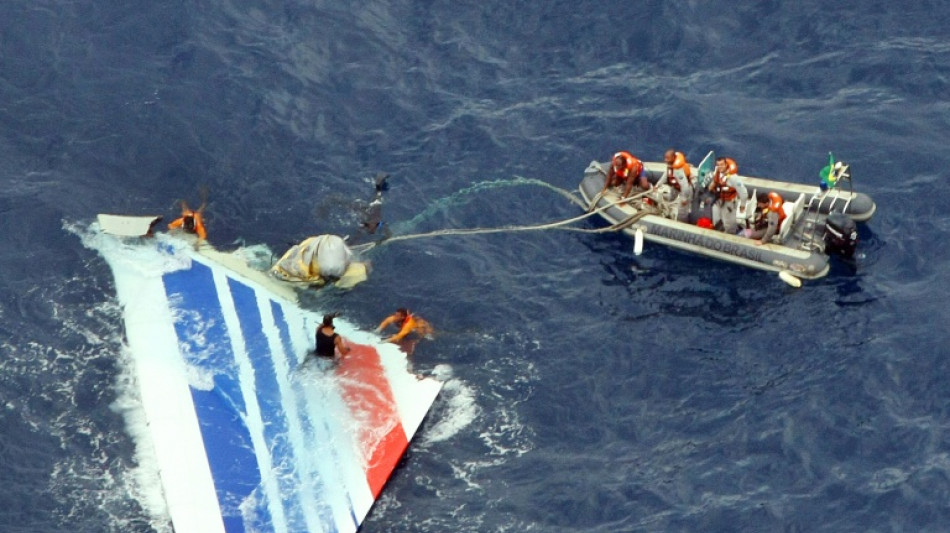
Air France, Airbus convicted of manslaughter in 2009 Paris-Rio crash / Photo: Handout - BRAZILIAN NAVY/AFP/File

A French appeals court Thursday convicted Air France and Airbus of involuntary manslaughter over the 2009 crash of a Rio-Paris flight that killed 228 people, the worst disaster in France's aviation history.
The Paris Court of Appeal ruling was a dramatic reversal of a lower court decision.
The appeal court said that the French flag carrier and Europe's leading aerospace manufacturer were "solely and entirely responsible for the crash of flight AF447," ordering each to pay 225,000 euros ($261,000) -- the maximum fine for corporate manslaughter.
While the penalties are symbolic, the ruling will be seen as significant reputational damage for both companies.
Air France and Airbus have consistently denied any criminal liability, blaming pilot error.
The lower court ruling acquitted them in 2023, finding that the companies had made mistakes but could not be proven to have caused the crash.
But on Thursday presiding judge Sylvie Madec, said the lower court had not taken into account "the existence of the causal chain within which the pilots' actions occurred, and which led to the deaths of all the passengers.
"The AF447 crash was a disaster waiting to happen -- and one that could have been avoided if each of the companies involved had fully grasped the seriousness of the failure," she added.
Airbus said it would lodge an appeal. There was no immediate reaction from Air France.
- 'Pain of families' -
The families of those killed in the crash praised the ruling.
Daniele Lamy, the head of an association of families of the victims, said that after a 17-year legal battle the justice system had finally taken into account "the pain of the families faced with a collective tragedy of unbearable brutality."
"It is also a ruling which, for the first time, convicts multinational aerospace companies and places safety above any other economic consideration," Lamy said.
"These prestigious firms will no longer be able to hide behind their self-satisfaction and technological pride."
On June 1, 2009, Air France Flight AF447, travelling from Rio de Janeiro to Paris, was cruising over the Atlantic when the pilots lost control of the aircraft, causing it to plunge into the ocean.
There were no survivors among the 216 passengers and 12 crew on board the Airbus-built A330 aircraft, the dead including 72 French nationals and 58 Brazilians.
Although prosecutors in 2023 had asked for the charges to be dropped, they had subsequently lodged the appeal.
The eight-week appeal trial ran between September and December last year.
The ruling was a "great source of satisfaction", said Olivier Morice, a lawyer for the civil parties.
"This is an extremely long judgement, more than 400 pages, it's very technical," he added.
Lawyers for the families have argued that both companies were aware of the problem with the pitot tubes, used to measure flight speed. But the pilots were not trained to deal with such a high-altitude emergency.
The court heard how a malfunction with the tubes, which became blocked with ice crystals during a mid-Atlantic storm, caused alarms to sound in the plane's cockpit and the autopilot system to switch off.
Experts highlighted how, after the instrument failed, the pilots put the plane into a climb that caused the aircraft to stall and then crash into the ocean.
- 'Absolutely dreadful situation'-
Simon Ndiaye, a lawyer for Airbus, said the ruling had nothing to do with "justice, the law, or safety."
"The legal battle will continue," he said. "On a human level, Airbus reiterates its compassion for the victims' families."
The manufacturer had emphasised what it describes as erratic crew behavior and flawed decision-making during the emergency, as the aircraft entered a stall.
The appeals court held Airbus responsible for several faults, including underestimating the seriousness of problems with sensors and failing to properly inform the crews of operating airlines.
Air France was found guilty of having failed to provide pilot training and to adequately inform flight crews.
Without ruling out that "pilot errors" may have been made during the 4 minutes and 30 seconds between the icing of the sensors and the impact with the ocean, the court nevertheless considered that the crew had not been sufficiently prepared to deal with the "extremely complex failure".
"They went as far as their abilities allowed, and nothing can be held against them."
鄭-H.Zhèng--THT-士蔑報