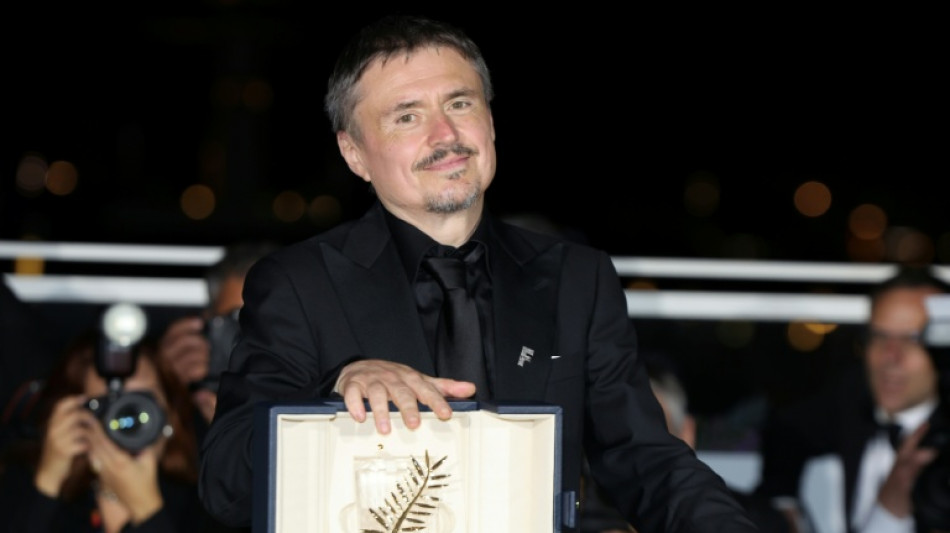
Mungiu wins Cannes again with culture wars drama / Photo: Thibaud MORITZ - AFP

Cristian Mungiu, who won the top prize at the Cannes Film Festival on Saturday with "Fjord", is not a man who is afraid of taking on difficult issues.
He won his first Palme d'Or almost 20 years ago with "Four Months, Three Weeks, Two Days", a gruelling indictment of the criminalisation of abortion in Romania that left audiences wincing.
This time he took on another prickly subject with his story drawn from a real-life culture war story of a conservative Christian family whose children are put into care because they are suspected of smacking them.
It raises questions about the prejudices of well-meaning progressive left-wingers without taking a clear position and left many critics at Cannes hotly debating Mungiu's views.
"Much more should be expected of a progressive society that believes it has found the right answers for the future and still considers itself superior," Mungiu, who is only the 10th filmmaker to win two Palmes at Cannes, told AFP this week.
The director put together an A-list cast that includes Norwegian star Renate Reinsve of "Sentimental Value" fame and Sebastian Stan, who played Donald Trump in "The Apprentice".
The story covers a familiar theme in Mungiu's work -- the anxieties of a remote community confronted with the arrival of newcomers, in this case a devout Christian family.
"I'm not here to make people feel comfortable," he told AFP.
- 'Try to fix things' -
Mungiu and other New Wave Romanian directors have shone at international festivals for the past two decades with often gritty stories of the country's post-communist transition.
"Sometimes what we put in our films is not very nice, but if we don't like what we see, you should try to fix things," he told AFP in 2016.
Mungiu himself was among tens of thousands who rallied against corruption and controversial judicial reforms in massive 2017 Bucharest protests that eventually brought down the government.
"Before becoming a filmmaker, I am a citizen of this country. I am raising my children here and I would have liked this country to have progressed more" since the fall of communism in 1989, Mungiu said.
In his movies, Mungiu makes ample use of sequence shots, avoids working in studios and prefers natural decors.
"I like it when the environment also tells its story," he has said.
Born in Iasi city in northeast Romania, Mungiu studied English and American literature at the local university before going to film school in Bucharest.
During his film studies he worked as assistant director on foreign productions made in Romania, notably French director Bertrand Tavernier's "Captain Conan".
After finishing his studies, he worked as a teacher and then as a journalist before turning to filmmaking.
After directing several short films, he made his first feature, "Occident", which was a critical success and was shown in the Director's Fortnight sidebar at the Cannes Film Festival in 2002.
Mungiu founded his own production company, Mobra Films, the following year.
- 'Ambitious works' -
Four years later, in 2007, he won the top Palme d'Or at Cannes for the harrowing "Four Months, Three Weeks, Two Days" about an illegal abortion in the 1980s communist Romania of dictator Nicolae Ceausescu.
In 2012, his drama "Beyond the Hills", which looks behind the walls of an Orthodox convent, won him the best screenplay award at the festival and the two protagonists shared best actress.
He won again in 2016, this time named best director for "Graduation", a film about fatherhood and the corruption undermining the Romanian education system.
He has also been a member of various juries at Cannes.
彭-C.Péng--THT-士蔑報