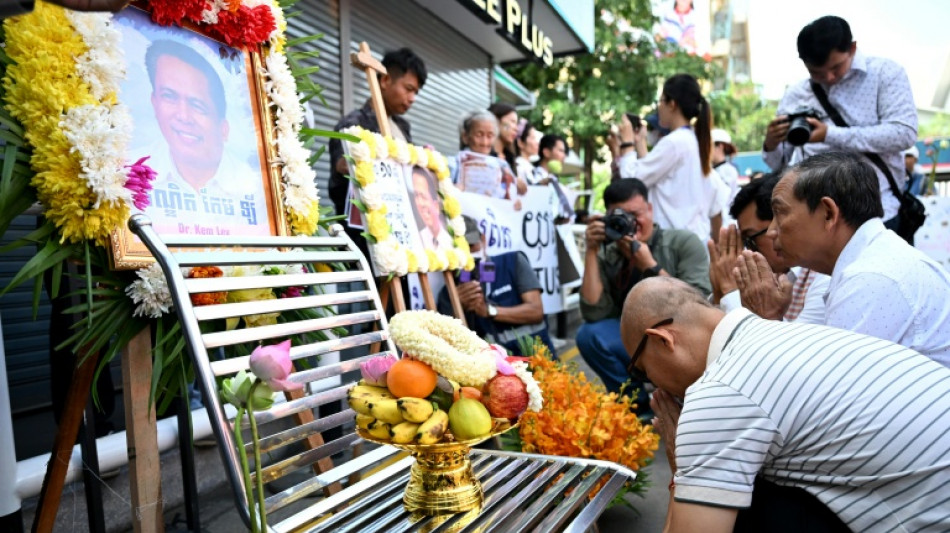
Fear, arrests keep Cambodians quiet decade after critic's murder / Photo: TANG CHHIN Sothy - AFP
Union leader Chhim Sithar served two years in prison after going up against the Cambodian government. Today, she is still making her voice heard, but it is getting riskier.
"Freedom in Cambodia has been shrinking and it is very difficult to speak out," she told AFP at a demonstration this month marking 10 years since the murder of Kem Ley, a prominent government critic gunned down in the capital.
"We are really worried," said the 37-year-old, who was jailed after leading a strike at the nation's largest casino, which authorities deemed illegal.
Since Kem Ley's death, former Cambodian leader Hun Sen and his son, Prime Minister Hun Manet, have tightened their grip over the country they have led for more than 40 years, analysts and rights activists say.
Cambodia has four times as many political prisoners today as compared to 2016, the year Kem Ley was shot dead in a Phnom Penh cafe.
A popular political commentator, he was killed soon after giving an interview about an investigative report that detailed some of the millions of dollars allegedly amassed by the ruling family.
At the memorial rally outside the site of Kem Ley's murder, Chhim Sithar said she feared being jailed again, but there was a wider issue at stake.
"What we fear more is the loss of our rights," she said.
- 'Speak the truth' -
Cambodia's main opposition party was banned and its leader Kem Sokha jailed the year after Kem Ley was killed, while several independent media outlets have since been shuttered.
The ruling Cambodian People's Party (CPP) swept the two general elections that followed without a viable challenger, making the country a de facto one-party state.
Opposition politician Rong Chhun said civil rights and political freedoms have been reduced to almost zero.
"Nothing has been improved," he told AFP, adding that while Cambodia still had public intellectuals, no one matched up to Kem Ley.
"There is nobody who has the courage to analyse or to speak the truth about society."
Cambodians who criticise the government are regularly arrested -- whether they are politicians, activists, farmers or tuk-tuk drivers.
Local rights group Licadho has documented at least 125 political prisoners jailed in Cambodia today, up from about 30 in 2016.
Among them are five members of outlawed environmental group Mother Nature imprisoned in 2024 for between six and eight years for plotting against the state, charges condemned by the UN and rights campaigners.
Others have faced the same fate as Kem Ley, with veteran opposition politician Lim Kimya shot dead last year while visiting Thailand, allegedly by a hired killer.
A former soldier is serving life in prison after confessing to Kem Ley's murder, saying he was motivated by an unpaid debt, but some claim the commentator was killed for speaking out against government corruption.
The government has denied any role in his murder.
- 'Unhappy' politicians -
Rights watchdogs have long accused Cambodian authorities of using violence, arrests and the CPP-dominated courts to silence critics.
"Risks can happen anytime if we speak about something that makes politicians unhappy," analyst Meas Nee told AFP.
Territorial disputes remain a sensitive subject, especially after military clashes with Thailand last year that saw Bangkok assert control over disputed border lands.
Meas Nee admitted that he too speaks more cautiously since Kem Ley was killed.
"It is not that we are not speaking about the truth, but we can only speak of the truth between 50 to 60 percent of the 100 percent," he said.
In a message to AFP, the government's Information Minister Neth Pheaktra said: "Cambodia does not criminalise criticism."
"The government welcomes constructive, evidence-based criticism, but all organisations must operate transparently, professionally and in accordance with Cambodian law."
- Private forums -
Kem Sokha, leader of the court-dissolved opposition Cambodia National Rescue Party (CNRP), was pardoned in May after serving nearly a decade of a 27-year sentence for treason.
But his political rights, including holding office and voting, remain revoked.
Recent Western aid cuts have meanwhile left NGOs that support Cambodian civil society groups floundering.
Licadho's operations director, Am Sam Ath, said it had lost 30 to 35 percent of its budget after reductions in US aid under President Donald Trump.
Another group, Politkoffee, held public forums nearly every week in Phnom Penh for more than eight years, providing a rare outlet for young Cambodians to debate politics.
But nowadays it hosts small meetings in a private setting, after the German think tank that hosted them withdrew its support, one Politkoffee member told AFP.
"We just try to keep ourselves low profile," the member said.
"The young people right now... when they hear the political words, they are afraid."
劉-T.Liú--THT-士蔑報