Search for missing after Nepal-Tibet floods kills at least 160 / Photo: Prabin RANABHAT - AFP

Rescue teams rushed Thursday to find hundreds of people missing on the Nepal-Tibet border in flash floods and landslides that killed at least 160 and swept away entire villages.
A terrifying clip of surveillance video from the Chinese side of the frontier shows a massive wall of mud and debris crashing over a building several stories high on Wednesday morning, engulfing it as dozens of people ran for their lives below. The surge swept away buses and cars like they were toys.
Many of the missing are foreign tourists, officials said of the disaster, which the US Geological Survey said was caused by a glacial collapse that sent a flow of debris engulfing areas along the way.
The surge of water hit villages and towns on the path of two rivers -- Bhote Kosi and Trishuli.
Resident Raju Bhadel, 56, recounted receiving a call from his brother-in-law in distress.
"They were crying and said their entire house had been swept away. Three family members were rescued, but his brother is still missing," he said.
Nepali police said they had recovered 157 bodies, with officers racing to move families in flood-risk areas to safety.
Chinese state media reported "major casualties" from a mudslide at the Tibet border hub Gyirong, reporting three dead and another 265 people missing.
Tibet government officials mobilised nearly 800 emergency workers and 150 vehicles as well as sniffer dogs and speed boats to help the rescue efforts, China's state-run news agency Xinhua said.
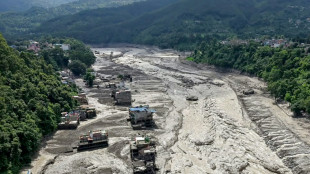
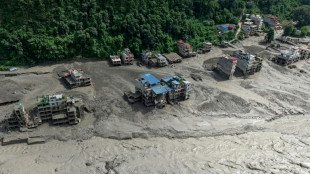
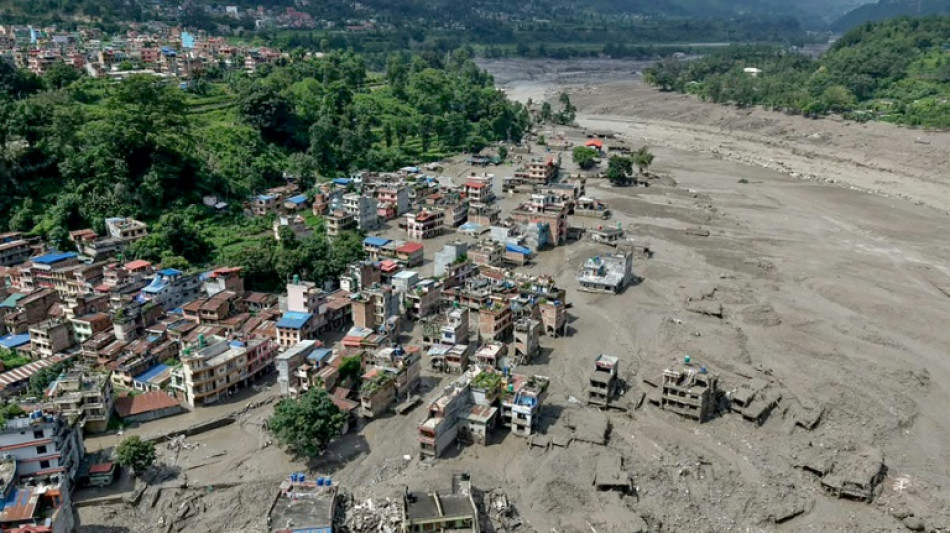
In the area hit by the disaster, rescuers waded through mud and sludge to look for survivors after floodwaters buried the lower floors of multi-storey buildings.
Some 403 tourists -- 341 of them foreigners -- were unaccounted for several hours after the disaster struck, according to Nepal's tourism ministry.
The missing foreigners included 142 Indians, and others from Australia, Britain, Malaysia, the Netherlands, Portugal, South Africa, South Korea and the United States, the tourism board said.
"Entire villages and market areas have been wiped out," said David Fisher, the Nepal head of the International Federation of Red Cross and Red Crescent Societies (IFRC).
It said it was dispatching emergency supplies including blankets, first aid kits, stretchers and body bags.
- Entire houses swept away -
Experts cautioned that a lingering blockage in a river could produce an additional flood.
Images shared by Nepali police showed floodwater surging through a river, sweeping away houses in its path, while AFP images depicted the top floor of a house sticking out from muddy soil.
The Nepali Army was carrying out flights and had rescued scores of people, while others living near the river in danger zones had been told to relocate.
The US Geological Survey said Thursday that seismic activity initially reported as an earthquake "was instead a glacial collapse and debris flow" that "caused subsequent catastrophic impacts downstream."
Chinese state broadcaster CCTV reported on Wednesday that "a mudslide disaster" on the Nepali side resulted in "major casualties and missing people" at the Gyirong Port in Tibet.
China's leader Xi Jinping said that "the most urgent task is doing everything possible to search for and rescue the missing people", according to CCTV.
Monsoon rains from June to September regularly trigger deadly floods and landslides across South Asia.
Scientists say climate change is increasing the frequency and intensity of extreme weather events in the region.
Qianggong Zhang, head of climate and environmental risks at the Kathmandu-based International Centre for Integrated Mountain Development (ICIMOD), warned of the potential for a second flood.
"With a blockage still lodged upstream on the Nepal-China border river, authorities warn a second flood may occur," he told AFP.
burs-oho/hmn
張-C.Cheung--THT-士蔑報