Nigeria's 'Kannywood' tiptoes between censor boards and modernity / Photo: OLYMPIA DE MAISMONT - AFP/File

Long overshadowed by south Nigeria's Nollywood, filmmakers in the north of Africa's cinema powerhouse are pushing boundaries in search of international eyeballs -- all while navigating the Muslim-majority region's social conservatism.
Young creatives -- influenced not just by their peers in the wealthier Christian south of the country, but even as far as India -- are hoping to expand the audience beyond Nigeria's borders for the north's frenetic "Kannywood" cinema industry, known for churning out some 200 films a month.
With some 80 million speakers of the north's Hausa language spread across west and central Africa -- not to mention the vast Nigerian diaspora around the world -- Kannywood's potential market is huge.
Yet reconciling international expectations with local constraints is no easy task: Islam's sharia law code runs alongside common law in Kano state, the bustling cultural hub of northern Nigeria, and a government censor board reviews music and film production.
Kamilu Ibrahim is among the directors hoping to break the mould -- in addition to pushing to include "aspects that are not commonly seen in Hausa films", Ibrahim has also put English and Arabic subtitles in his work in a bid to reach a wider audience.
Filmmakers still find a way to focus on the same themes that dominate Nollywood: love, vengeance and treason all make good fodder for the at times over-the-top melodrama Nigerian movies are known for.
But nudity, "sexual scenes" as well as "content that is contrary to customs, traditions, and religion" are all out of bounds, Abba El-Mustapha, an actor and director who also serves as the executive secretary of the Kano State film censorship board, told AFP.
- Hausa-focused streamers -
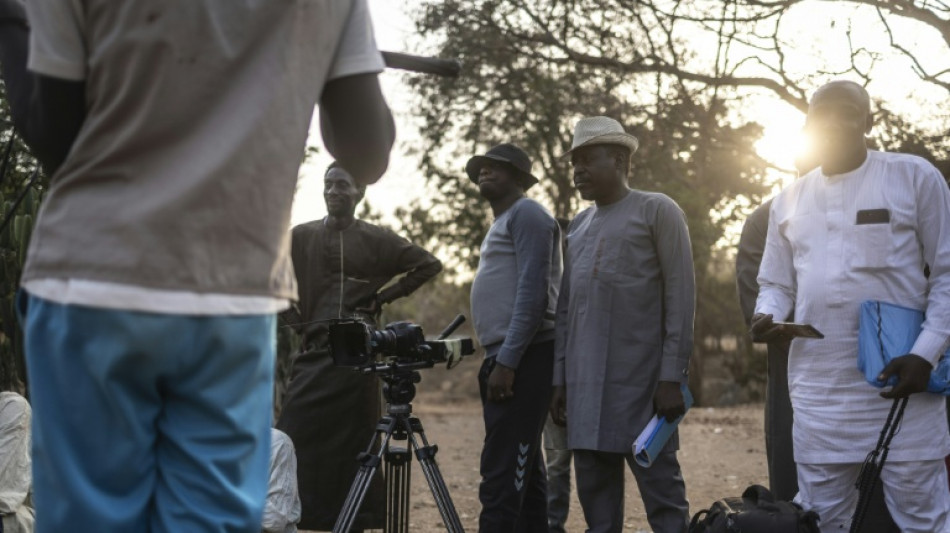
When AFP visited Ibrahim's set last year, he was filming season two of "Wata Shida", a series about a woman confronted with the prospect of a forced marriage.
In order to get out of it, she marries another man, with both of them seeking the convenience of a partnership on paper, rather than real romance -- an on-the-nose plotline in a region where women and girls are frequently wedded to their parents' choice of husband.
"We are not used to seeing someone going out in pursuit of a dream without family consent," Ibrahim said, noting the importance of films to "question certain important social issues".
"Wata Shida" actor Adam Garba said he hopes to see the series broadcast on a major streaming platform one day -- though for now, it's available on YouTube.
Most Nigerian films on major streamers like Netflix and Amazon Prime are from the country's richer south, where Hausa is a minority language.
"They have more budget, more equipment, they have more sponsors, more investors," Garba told AFP.
That might be changing.
Freshly launched Arewaflix is a new streaming initiative from Abdurrahman Muhammad Amart, a Nigerian production company CEO.
Arewaflix will be a service "not only for Hausa films, but also for films in other languages from northern Nigeria", including Nupe and Kanuri, Amart said.
Subtitles are planned in English, French and Arabic.
It's not the first such attempt: Northflix, another Hausa-focused effort, shuttered in 2023 amid slow growth.
Getting people to pay for media is tough in any country. Nigeria -- where millions live in poverty, compounded by an economic crisis since 2023 -- is no exception.
"When a film is accessible to a hundred people on a platform with poor security, it can quickly be pirated and circulated everywhere," said Mustapha, the censor board secretary.
- Bollywood inspiration -
The industry is known for its scrappiness, but the key to international growth is better production equipment, said director Umar Abdulmalik.
With top-notch stories and production, the language barrier won't be an issue, he predicted, noting how India's Bollywood has become a media staple in Nigeria, despite many viewers not speaking English or Hindi, "because they are carried away by the characters' emotions".
For now, though, there's one tradition that Kannywood seems set to stick with: doing more with less.
On the set of "Wata Shida", the heat was rising as the call to prayer rang out from nearby mosques.
After calling cut, director Ibrahim called for another take.
"That's good, but we can do better," he said. "Let's do it again."
林-L.Lín--THT-士蔑報