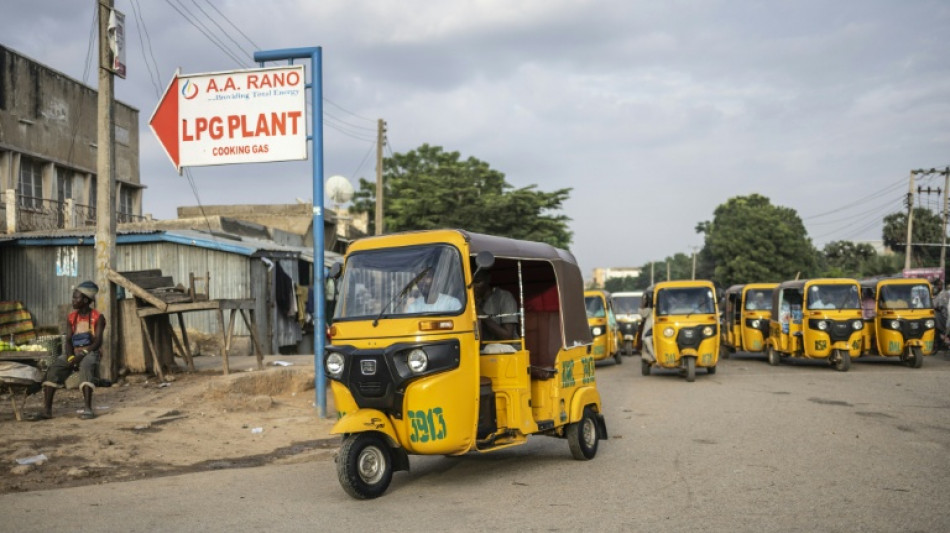
Conservative Nigerian city sees women drive rickshaw taxis / Photo: OLYMPIA DE MAISMONT - AFP/File

Sporting a pink knee-length veil, Umma Hani Yusuf Khalid has recently found financial stability as a rickshaw taxi driver, a trade that was unthinkable for her in Nigeria's conservative Muslim city of Kano two years ago.
As more women are having to fend for themselves amid economic hardship, they are increasingly venturing into trades previously dominated by men.
Khalid's pink three-wheeled electric rickshaw stood out on the frenetic streets of the region's commercial hub, as she pulled over to pick up women passengers.
The 35-year-old divorced mother of two is one of 100 women rickshaw taxi drivers plying the city's chaotic roads under Mata Zalla, a cooperative promoting women's empowerment.
"As a female rickshaw operator, you need to be strong because you made the resolve to go through all kinds of challenges," Khalid told AFP.
Khalid quit selling footwear 18 months ago to get in the driver's seat, which secured her a higher income and allowed her to rebuild her home and help her two nieces get married.
- 'Composed behind the wheel' -
The work is not easy. At daybreak, she commutes 15 kilometres (about 9.3 miles) to the Mata Zalla office and then taxis back, offering lifts to passengers headed to her neighbourhood.
She stops at home to feed her children and prepare them for school before returning to the busy streets.
Still, ever-smiling, Khalid said her trick is to "just remain composed behind the wheel. That's what is required from you."
Mata Zalla, which means "exclusively women" in the local Hausa language, seeks to create employment opportunities for women in an area gripped by poverty.
Kano State is one of 23 northern Nigerian states where Sharia law, based on the teachings of the Quran, runs parallel to state and federal justice systems.
Kano also has the highest divorce rate in the country, according to the city's Sharia police, Hisbah, leaving many women to support themselves and their children alone.
Mata Zalla secured a loan and partnered with an electric rickshaw assembling plant in the country's economic capital Lagos to establish a women's taxi business.
Women drivers have a portion of their daily wages deducted over three years, which then buys them their own rickshaw, according to Hauwa Ahmad Tarauni, co-founder of Mata Zalla.
"We thought that this is a lucrative business which women were not benefiting from and had been left for men," 50-year-old Tarauni told AFP in her office.
- 'A drop in the sea' -
Yellow petrol-powered rickshaws, largely imported from India, have become the main form of transportation for Kano's population of five million people since being introduced in 2005.
The roughly 60,000 polluting rickshaws are operated solely by men, according to city's traffic department.
Mata Zalla meanwhile set up two solar-powered charging stations where drivers can swap the vehicle's battery when it runs low, with the level monitored by a smartphone app.
The job has its risks, Khalid confessed, mainly due to aggressive drivers of private cars.
"They harass us, look down on us as women who are weak... they harass us by trying to hit us, as a way to soften us," she said.
But collisions involving the pink rickshaws have been rare and their drivers first undergo lessons at the city's vehicle inspection office.
With Islamic shariah law in effect statewide, men and women are discouraged from mixing in taxis.
Still, a segregated transportation system has not been enforced, leaving some women feeling vulnerable.
"A man can get too close to a woman, abuse her over small things or the operators, who are usually young men with crazy haircuts, quarrelling with female passengers," said Tarauni.
To address these challenges, Mata Zalla opted to restrict its rickshaws to women passengers.
"[I ride] because she is a woman like myself and it is not good for the woman to take a keke (rickshaw) with a man inside," Sarah Abner, a 32-year-old pregnant passenger, told AFP.
The programme has worked so well, Tarauni said she is having to apply for another loan to buy more rickshaws to supply some 200 women who are on a waiting list to join.
"The transportation market in Kano is huge, we need more rickshaws because the 100 we have are just a drop in the sea," she said.
孫-H.Sūn--THT-士蔑報