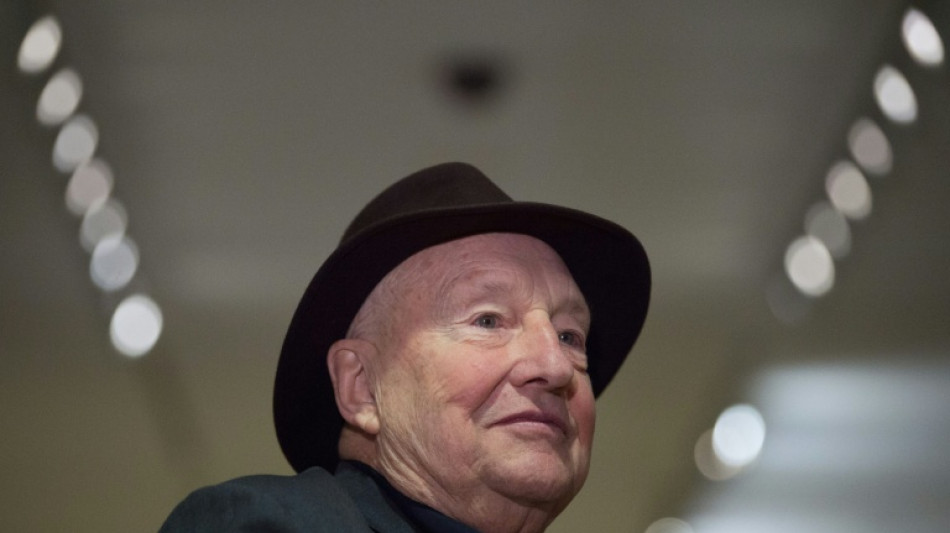
German artist Georg Baselitz dies aged 88 / Photo: Sebastian Kahnert - dpa/AFP

German artist Georg Baselitz, whose expressive paintings and sculptures stirred controversy in West Germany before winning global acclaim, has died aged 88.
His death was confirmed to AFP by Ropac Gallery, which had a long-standing professional relationship with the artist.
Baselitz, who "defined German visual art for a generation", had "died peacefully", the gallery said in a statement Thursday.
Baselitz, born Hans-Georg Kern, was among Germany's most prominent contemporary visual artists with a body of work over six decades across a range of techniques.
He adopted the name Baselitz in 1961 as a nod to Deutschbaselitz, the town near Dresden in eastern Germany where he was born in 1938.
His works, which reflect the traumas of German history, are now held in some of the most prestigious public collections and he has been the subject of numerous retrospective exhibitions since the 1990s.
Baselitz not only painted but also worked in the graphic arts and was a noted sculptor.
In 1969, he began painting canvases upside-down and inverting motifs, a technique he said sought to find a way between abstraction and straightforward figurative art.
Baselitz spent his early childhood in Nazi Germany and then grew up in communist East Germany.
He initially studied art in East Berlin but moved to West Berlin in 1957.
He burst into national attention in 1963 when authorities confiscated two paintings laden with sexual symbolism from the art gallery where they were on display, leading to a high-profile court battle.
Baselitz achieved his international breakthrough in the early 1980s and in recent decades has been among the most sought-after -- and highest-priced -- living German painters, alongside such names as Gerhard Richter and Anselm Kiefer.
何-H.Hé--THT-士蔑報