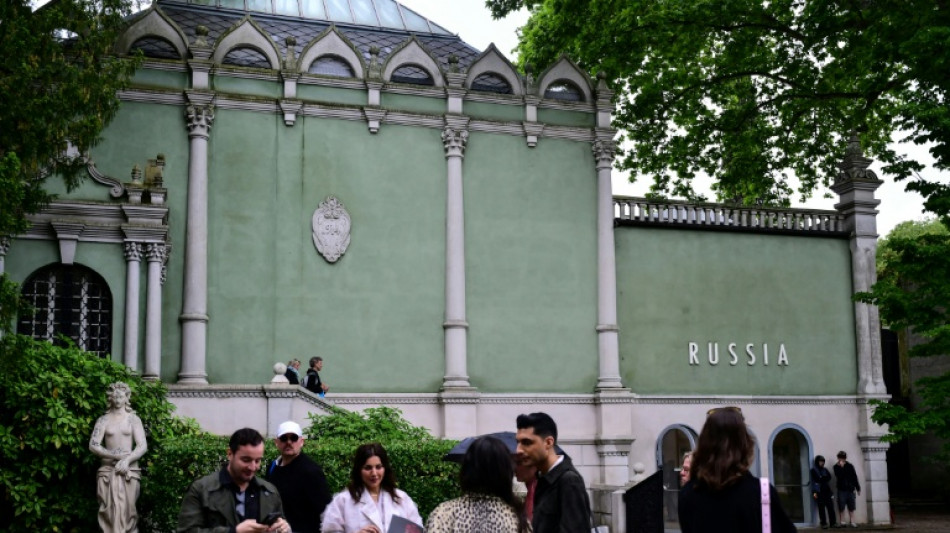
Venice Biennale opens in turmoil over Russian presence / Photo: MARCO BERTORELLO - AFP
Resignations, boycotts and threats to cut funding -- the Venice Biennale opens to the press on Wednesday in turmoil over the return of Russia for the first time since the Ukraine war broke out.
The world's largest contemporary art exhibition, which takes place every two years in the Italian canal city, features artists from several nations in conflict, including Ukraine, Israel and the United States -- although Iran has cancelled its plans to attend.
Russia was included for the first time since its 2022 invasion of Ukraine, a decision that sparked outrage from Italy's government and the European Union, which threatened to cut two million euros ($2.3 million) in funding for the event.
The Biennale jury last week resigned after saying they would not hand out awards to countries led by figures subject to arrest warrants issued by the International Criminal Court (ICC) -- meaning Russia and Israel.
In the end, the Russian pavilion will not be open to the public during the Biennale, which runs from May 9 to November 22.
Instead, musical performances for the exhibit -- "the tree is rooted in the sky" -- will be recorded during this week's press previews and projected on giant outdoor screens during the next six months.
They will involve around 30 "young musicians, philosophers and poets", mostly Russian but also from Mexico, Mali and Brazil, according to the project notes.
"I would like to thank the Biennale for endorsing the idea of having all countries represented here," the exhibition's curator, Anastasia Karneeva, said in a video on Instagram.
- EU opposition -
In 2022, shortly after Russia invaded Ukraine, the artists and curators in the Russian pavilion withdrew from the Biennale in protest.
In 2024, Russia was not invited -- but this year, organisers announced in March that it would take part, causing an immediate uproar.
In a letter to Biennale president Pietrangelo Buttafuoco, 22 European culture and foreign ministers asked him to reconsider, saying Russia's presence was "unacceptable" given Russia's continued "brutal war of aggression against Ukraine".
"Culture is not separate from the realities societies face," they wrote.
The European Commission later said it intended to "suspend or terminate" its grant of two million euros over three years.
"Cultural events funded by European taxpayers' money should safeguard democratic values, foster open dialogue, diversity and freedom of expression -- values which are not respected in today’s Russia," a spokesman said.
On Monday, the EU reportedly again wrote to the Italian government to request clarification on the conditions under which the Russian delegation is being hosted, amid concerns of a breach of European sanctions on Moscow.
According to leaked documents from an inspection by the Italian culture ministry last week, Biennale organisers argued that Russia has owned the Venice pavilion since 1914, and cannot be stopped from using it.
Culture Minister Alessandro Giuli -- who from the outset expressed the Italian government's opposition to Russia's inclusion -- has said he will not be going to Venice.
- A place of truce -
As a result of the jury's resignation and the "exceptional nature of the ongoing international geopolitical situation", organisers have postponed the award ceremony from May 9 to November 22, the last day of the exhibition.
The Biennale said it will hand out two awards, in which visitors can vote, one of which can be won by any national participant -- including Russia.
This followed the "principle of inclusion and equal treatment", it said in a statement.
"La Biennale seeks to be, and must remain, a place of truce in the name of art, culture, and artistic freedom," it said.
Biennale President Buttafuoco, who took office in March 2024, has maintained this line throughout.
"Art has a power far greater than any form of oppression. Art opens the way for the future and gives us the possibility of erasing catastrophes," he said on Monday.
何-H.Hé--THT-士蔑報