A Contemporary Art Museum Builds Local Roots in a Zhejiang County Town
The Art Museum of Pond Loach in Qingyuan County is testing how a contemporary art institution can grow through sustained work with residents, schools and local tradespeople.
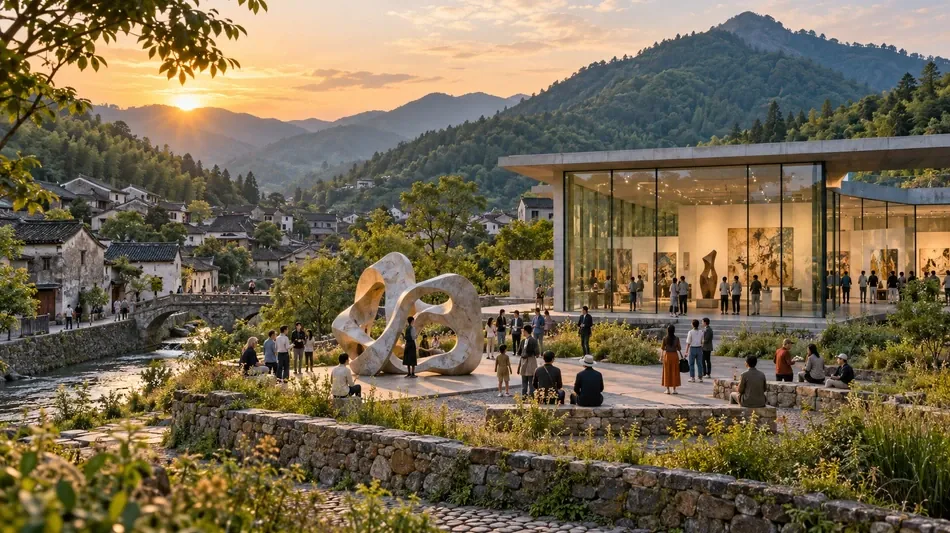
Qingyuan County sits about six hours by road southwest of Hangzhou, the capital of eastern China’s Zhejiang province. The route passes through mountain tunnels, hillside solar farms, white-walled villages and transmission towers before reaching a narrow valley. Despite improved transport links and its location in one of China’s wealthiest provinces, Qingyuan remains relatively remote and is best known outside the area for shiitake mushrooms and pencil production.
Daily life in the county town follows the rhythm of nearby factories and workshops. At dusk, electric moped riders return along a dedicated lane, gathering at traffic lights before moving off together. The scene reflects a form of settlement that is widespread in China but rarely central to cultural reporting: the xiancheng, or county town, where schools, hospitals, shops and government and cultural services support both urban residents and surrounding villages.
Qingyuan County recorded 141,000 permanent residents in 2023. Nationwide, about 160 million people lived in similar county towns at the end of 2021. A national policy issued in 2022 recognized their function as links between cities and rural areas and called for stronger public services, including museums.
Contemporary art in China has increasingly moved beyond Beijing and Shanghai. Art Field Nanhai has placed installations in the Guangdong countryside, the Bishan Project incorporated art into rural revitalization in Anhui, and the historic Sichuan town of Anren hosted three contemporary art biennales. Yet county towns, where urban and rural systems overlap, have received less attention.
Coverage of art outside major cities can also rely on the term xiachen, literally “sinking,” to describe cultural resources moving downward from metropolitan centers. That wording can obscure the role smaller communities play in determining how cultural projects take shape. The Art Museum of Pond Loach, or AMPL, offers a different model by treating local people and institutions as participants rather than a passive audience.
AMPL opened in Qingyuan in 2023 and takes its name from a small freshwater fish that burrows in mud. The museum uses the fish as an image for its aim of working in the space between urban and rural life and engaging with county residents’ everyday experiences. Director Hu Dingyu has described its focus as “modest yet significant contemporary art.”
Hu was born in Qingyuan, left as a child and later studied and worked as a curator in the Netherlands. She does not present her return as a nostalgic homecoming or a search for personal roots. Her stated goal was to create a durable institution where relationships among artists, staff and residents could develop over time.
The museum’s physical setting makes that approach visible. AMPL occupies two floors of a ceramics museum founded by a member of Hu’s family. The building, which also houses the local marriage registry and a library reading room, is dedicated primarily to celadon, the green-glazed ceramic tradition closely associated with Zhejiang.
Within that setting, AMPL created galleries with gray concrete walls, exposed reinforcement bars, pipes and alarm equipment. The unfinished surfaces contrast with the polished display cases used for celadon on the floor below. Rather than concealing the difference, the museum allows the contemporary space to appear provisional and still developing.
Its curatorial, research and education programs focus on county-town life. Artists are invited to stay in Qingyuan and make work with local residents. The process emphasizes ordinary encounters and local labor as much as finished objects. One project placed a modified “chariot” among the evening moped traffic; another used neighborhood shops and a dance hall that had long since disappeared as exhibition subjects.
The museum has also worked with schools. In cooperation with artists, AMPL made recordings of contemporary art classes at the China Academy of Art in Hangzhou available to Qingyuan high school teachers. The materials could then be used in local lessons, extending the museum’s activity from its galleries into classrooms.
Local tradespeople are essential to the institution’s operations. AMPL does not have a permanent exhibition-installation crew, so staff hire welders, electricians and other workers through personal contacts. Some workers who initially had no experience installing contemporary art have become regular collaborators since the museum opened. Those relationships now function as part of its practical infrastructure.
The 2026 exhibition “Factory Girl,” featuring artist Zheng Que and curated by Nie Xiaoyi, illustrates how this approach connects art with county manufacturing. Zheng began working in 2023 at a factory in Pan’an, another Zhejiang county, that produces Christmas goods. She filmed herself at work, making her own position as a factory employee central to the project.
Zheng said most employees at the factory were women from nearby villages, ranging from their 30s to their 70s and 80s. Many were retired and wanted an activity to occupy their time. Coworkers were often neighbors or relatives as well, linked through overlapping networks of family and acquaintances. The Christmas products they made, like Qingyuan’s pencils, tied county labor to customers far beyond the local area.
At the exhibition opening, visiting artists, curators and other art professionals arrived from Shanghai and Hangzhou. A shared meal featured loach hotpot—the local dish based on the fish that gave the museum its name—and Qingyuan shiitake mushrooms, prepared by residents. Such events bring outside art networks into direct contact with local food, labor and social relationships.
The resulting exchange is more reciprocal than the idea of cultural resources simply “sinking” from a major city. Artistic methods and professional networks developed elsewhere are grafted onto local institutions, skills and routines, while Qingyuan’s conditions affect what the artists and museum can produce. Architecture, classroom partnerships, workshop labor and repeated personal contact all shape the program.
AMPL’s long-term survival is not assured. Funding and professional networks from large cities will remain important, but the museum must also preserve the time and continuity needed for artists to work with residents beyond a single exhibition. Its future will depend on whether collaboration becomes an established practice and whether people in Qingyuan continue to have a role in deciding how the institution develops.
The experiment therefore has significance beyond one county museum. It shows how contemporary art might grow outside China’s largest cities without treating smaller communities merely as venues. Qingyuan’s experience suggests that county towns can help define the work, supply knowledge and skills, and participate in the continuing life of a cultural institution.
何-H.Hé--THT-士蔑報