Fingerprint Study Finds Women and Teenagers Helped Build China’s Terracotta Army

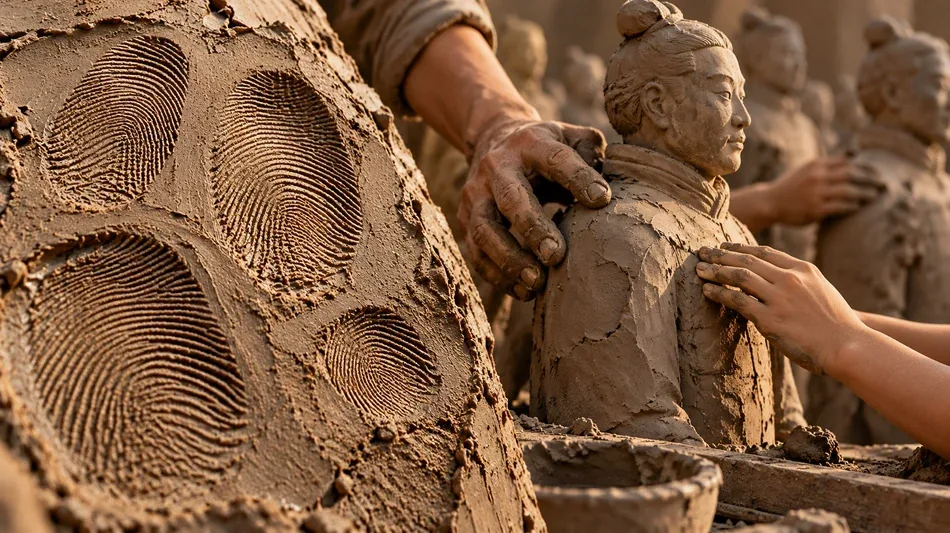
Women and adolescents as well as adult men took part in producing China’s 2,000-year-old Terracotta Army, according to a new fingerprint study that examines the labor behind the mausoleum of the first emperor, Qin Shi Huang. The researchers analyzed ancient prints preserved on clay figures and assessed the makers’ li
Women and adolescents as well as adult men took part in producing China’s 2,000-year-old Terracotta Army, according to a new fingerprint study that examines the labor behind the mausoleum of the first emperor, Qin Shi Huang. The researchers analyzed ancient prints preserved on clay figures and assessed the makers’ likely ages and sexes.
The work was conducted by the Emperor Qinshihuang’s Mausoleum Site Museum in Xi’an, Shaanxi province, and the School of Archaeology at Shandong University in Jinan. It is scheduled for publication in Volume 82 of the Journal of Cultural Heritage at the end of 2026. Domestic media reported the findings this week.
Earlier accounts of Qin dynasty labor, dating from 221 to 206 BC, relied heavily on legal texts and often treated adult men as the default workforce; 15 was reported as the minimum age for service. Earlier fingerprint research also did not fully address the overlap in ridge size between women and adolescent boys, differences between ancient and modern prints or the shrinkage of clay during firing.
The research team used a Bayesian mixture model to incorporate those uncertainties. It assigned probabilities for possible age and sex, analyzed mean ridge breadth, or the thickness of fingerprint ridges, and compared the measurements with values projected from growth curves.
Researchers examined 79 well-preserved fingerprints on 36 figures from Pit 1 at the Qin mausoleum. Their estimates attributed 45% of the prints to males, 32.7% to females and 22.3% to juveniles younger than 15. The results provide quantitative biological evidence against the assumption that large state craft projects relied only on adult male labor.
The authors said the pattern is consistent with historical material describing state workshops where men and women worked together and experienced adults worked beside juveniles who may have served as helpers or apprentices. They also said the method offers a new framework for studying the ages and sexes of workers involved in ancient craft production.
The paper notes important limits. The percentage of fingerprints in each category does not necessarily equal the percentage of workers because several prints may have come from one person. Experienced artisans may also have left fewer prints, which could inflate the apparent share attributed to juveniles.
The comparison database presents another source of uncertainty: it is based on modern Czech-Caucasian fingerprints rather than East Asian samples and contains more female prints, conditions that may affect the estimates. The authors therefore frame the findings as probabilistic evidence, not an exact census of the workforce.
張-H.Zhāng--THT-士蔑報