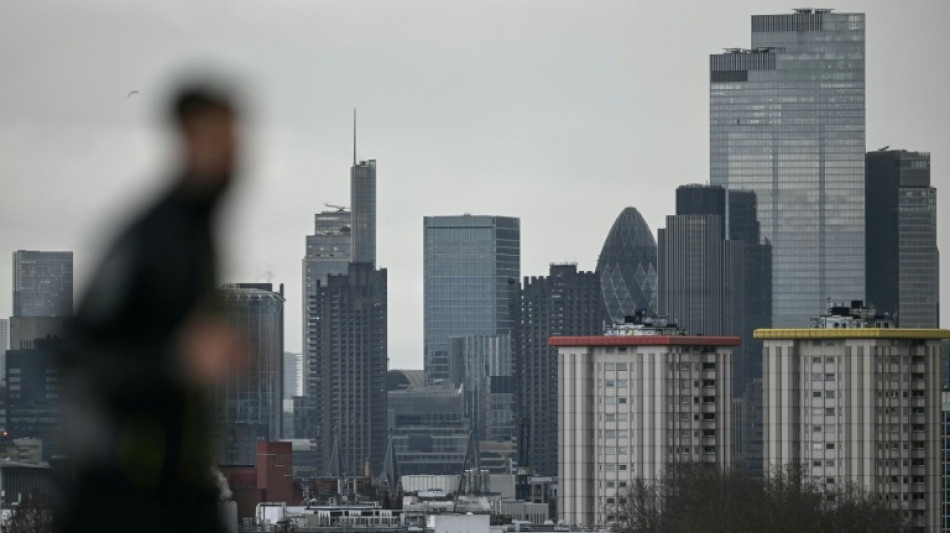
UK economy struggles for growth in fresh blow to government / Photo: JUSTIN TALLIS - AFP

Britain's economy grew less than expected in the final quarter of 2025, according to official data Thursday, dealing a fresh blow to embattled Prime Minister Keir Starmer and his government.
Gross domestic product expanded 0.1 percent in the October-December period as the key services sector and construction suffered, the Office for National Statistics (ONS) said in a statement.
Analyst expectations had been for overall GDP growth of 0.2 percent for the fourth quarter.
The data comes after Starmer has in recent days fought off calls to resign over the Jeffrey Epstein scandal.
Starmer appointed Peter Mandelson as US ambassador despite knowing of his links to Epstein, a convicted sex offender.
- 'Right economic plan' -
The prime minister's Labour party has struggled to revive Britain's sluggish economy since winning a general election in July 2024, having raised taxes in its two annual budgets to fund increased public spending.
Starmer is deeply unpopular with the public and trails Nigel Farage's hard-right Reform UK party in polls, although the next general election is likely three years away.
He faces a difficult by-election later this month and key local polls in May.
The ONS on Thursday added that Britain's GDP grew 1.3 percent in 2025, which compares with 1.5 percent expansion for the eurozone.
Reacting to the latest UK data, finance minister Rachel Reeves said "the government has the right economic plan to build a stronger and more secure economy".
Speaking Wednesday, Reeves insisted that closer integration with the European Union is the "biggest prize" for Britain's economy.
The UK has sought to bolster trade ties across the world since departing the EU at the start of the decade.
Under Starmer, the Labour government has struck long-sought trade deals, including with the United States and India, in the hopes of boosting investment and growth.
Nevertheless the UK economy was hampered last year by US President Donald Trump's tariffs blitz on the world.
- Exports to US down -
Separate ONS data Thursday showed UK exports of goods to the United States dropped 10 percent last year to £59 billion ($81 billion).
Britain's vehicle production tumbled in 2025 owing to the tariffs uncertainty and a cyberattack on Jaguar Land Rover.
A US-UK trade agreement, which entered into force in June, reduced the tariff on British car exports to 10 percent from 27.5 percent, on a limit of 100,000 vehicles annually.
The British pharmaceutical industry waited until December before the US exempted it from import tariffs under a unique deal which sees the UK increase spending on American drugs by 25 percent.
Despite Trump rolling back his most aggressive tariffs threats, many British companies have held back from making major investment decisions owing to the uncertainty triggered by the president's trade policies.
The Bank of England last week cut its forecasts for UK growth this year and next.
The BoE estimates GDP growth of 0.9 percent in 2026 and 1.5 percent next year.
It had previously forecast output of 1.25 percent for 2026 and 1.6 percent for next year.
The growth downgrades came alongside the central bank's decision to leave its benchmark interest rate at 3.75 percent as UK inflation stays above the BoE's two-percent target.
British inflation is set to cool in the coming months as easing energy bills help to offset rising water bills and other elevated costs.
UK unemployment stands at 5.1 percent, close to a five-year high.
While Thursday's growth data "will do nothing to alleviate pressure on the deeply unpopular Labour government, there may be faint light at the end of the tunnel", noted Matthew Ryan, head of market strategy at global financial services firm Ebury.
"UK inflation is set to fall, and we have yet to see the full transmission of Bank of England interest rate cuts, which should help lower borrowing costs and boost household spending."
文-L.Wén--THT-士蔑報