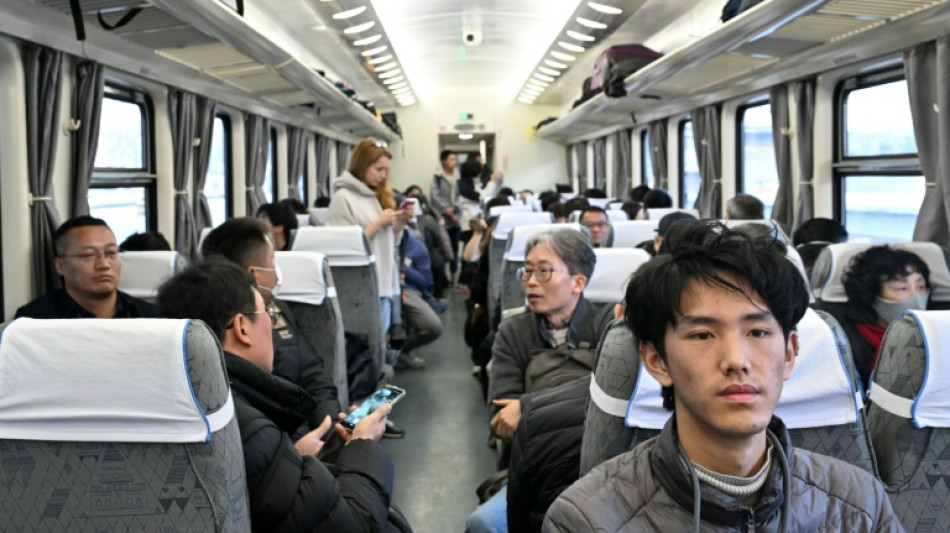
China-North Korea train arrives in Pyongyang after 6-year halt / Photo: ADEK BERRY - AFP

A passenger train from China arrived in the North Korean capital on Thursday, state media said, after a six-year hiatus since the service was suspended during the Covid-19 pandemic.
China is North Korea's largest trading partner and a vital source of diplomatic, economic and political support for the isolated nuclear state.
Train journeys between the East Asian neighbours were halted in 2020 under strict border closures to prevent the coronavirus from spreading.
China's state news agency Xinhua said a train that departed from Dandong, a city in the northeast bordering North Korea, arrived in Pyongyang on Thursday evening.
South Korea's Yonhap news agency reported earlier that a train had been seen crossing the Sino-Korean Friendship Bridge over the Yalu River.
China Railways said in a separate statement that regular train services would also resume between Beijing and Pyongyang on Thursday evening.
AFP journalists aboard the K27 train departing from Beijing and bound for Pyongyang on Thursday saw carriages reserved only for passengers travelling to North Korea.
Several people at the station gathered around the departures board to take photos of the "Beijing to Pyongyang" listing.
The overnight train is set to make a few stops, including at the port city of Tianjin, and then head northeast to Dandong on the border.
A railway enthusiast at the station told AFP he was taking the train only one stop and would disembark at Tianjin.
"It's great that this line is reopening, because there are very few international rail connections in China," he said, before being subjected to an ID check by plainclothes police officers.
- Change trains -
Wagons from Beijing holding Pyongyang-bound passengers are then attached to another train in Dandong, taking them across the border to the nearby North Korean city of Sinuiju, said Rowan Beard from Young Pioneer Tours, a company specialising in North Korea travel.
Those wagons, as well as North Korean domestic carriages, will then be attached to a new train heading to Pyongyang, he added.
Trains will run in both directions between Beijing and Pyongyang every Monday, Wednesday, Thursday and Saturday, China Railway said.
The Dandong-Pyongyang service would operate daily, it said.
Travel agents for an official ticketing booth in Beijing told AFP on Tuesday that anyone with a valid visa can now buy train tickets to the North.
That includes Chinese people working and studying in North Korea, as well as North Koreans working, studying and visiting family abroad.
Entry and exit procedures would be completed at the Dandong border crossing and at Sinuiju in North Korea, China Railway said.
Tickets are currently available for offline purchase in several Chinese cities, it added.
- 'Re-normalisation' -
The resumption of the train link symbolised a return to a stronger bilateral relationship, said Lim Tai Wei, a professor and East Asia expert at Japan's Soka University.
It signalled greater access to "the largest trading nation on Earth" for North Korea, Lim told AFP, while it was also important for China's "periphery diplomacy".
A spokesman for China's foreign ministry said on Thursday that "maintaining regular passenger train services is of great significance for facilitating personnel exchanges" between the two countries.
Beijing has been a crucial lifeline for North Korea's moribund economy.
China has fully reopened its borders since the pandemic, but North Korea has proceeded more slowly. Direct flights and train services with Russia resumed last year.
While the resumption suggests a "re-normalisation" of contact between China and North Korea, it does not necessarily mean increased support from Beijing, said Associate Professor Chong Ja Ian from the National University of Singapore.
"A lot of the previous limit on contact seems to be due to Pyongyang's apprehensions about broader contact, which have diminished," Chong told AFP.
李-X.Lee Li--THT-士蔑報