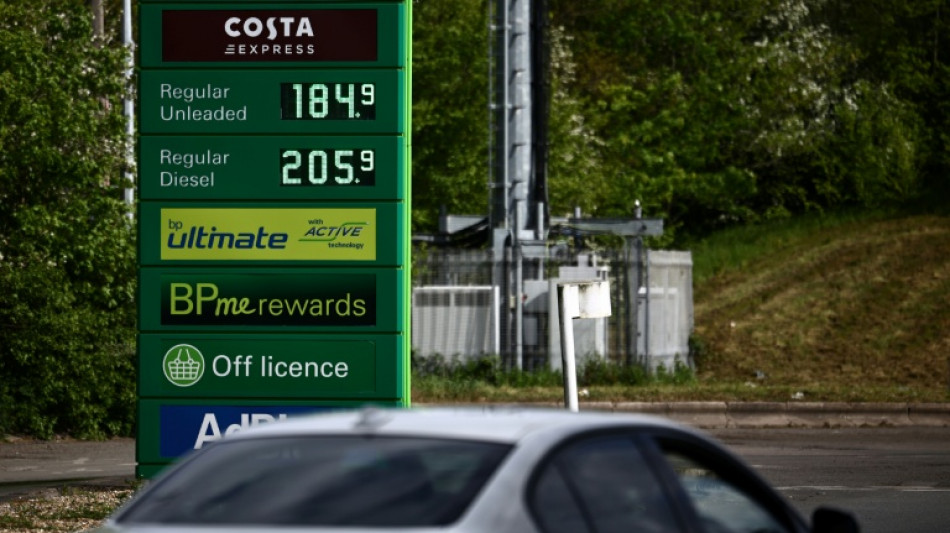
UK inflation jumps as Mideast war propels energy prices / Photo: Henry NICHOLLS - AFP

Britain's annual inflation rate jumped to 3.3 percent in March as the Middle East war sent oil and gas prices surging, official data showed Wednesday.
The Consumer Prices Index (CPI) increased from 3.0 percent in the 12 months to February, the Office for National Statistics said in a statement.
"Inflation climbed in March, largely due to increased fuel prices, which saw their largest increase for over three years," Grant Fitzner, chief economist at the ONS, said in a statement.
Finance minister Rachel Reeves reiterated the Labour government's opposition to a conflict that has increased the cost of living for millions of Britons.
"This is not our war, but it is pushing up bills for families and businesses. That's why it's my number one priority to keep costs down," Reeves said in a statement.
On Tuesday, she announced a plan to raise the government's windfall tax on low-carbon electricity generators to 55 percent from 45 percent in a bid to support households and businesses.
However, she has resisted calls to directly lower energy costs for consumers.
At 3.3 percent, the latest UK inflation figure matches the March reading for the United States. But the pace of the CPI increase in the world's biggest economy was far sharper, having stood at 2.4 percent in February.
Britain's inflation rate is also much larger than in the eurozone, where annual inflation rose to 2.6 percent in March from 1.9 percent in February.
Energy prices have skyrocketed since the US-Iran war began on February 28, though they have since pulled back on a ceasefire that US President Donald Trump extended Tuesday.
But oil and gas prices remain far above their pre-war levels as Gulf supplies remain largely blocked from transiting the Strait of Hormuz.
- Interest rate outlook -
Analysts said that despite the rising UK inflation, the Bank of England would likely resist raising its main interest rate at a regular meeting next week -- and possibly for the rest of the year -- with the country's economic growth set to weaken owing to the war.
"While the increase in prices will be felt keenly at the petrol pump, it is highly unlikely a single inflation print will be enough to sway policy makers into moving the Bank of England base rate," said Emma Wall, chief investment strategist at Hargreaves Lansdown.
The International Monetary Fund has sharply downgraded its forecast for Britain's economic output this year because of the conflict, estimating growth of 0.8 percent rather than expansion of 1.3 percent it predicted in January.
袁-J.Pān--THT-士蔑報