Musk 'wanted 90%' of OpenAI, Altman tells tech titan trial / Photo: JOSH EDELSON - AFP

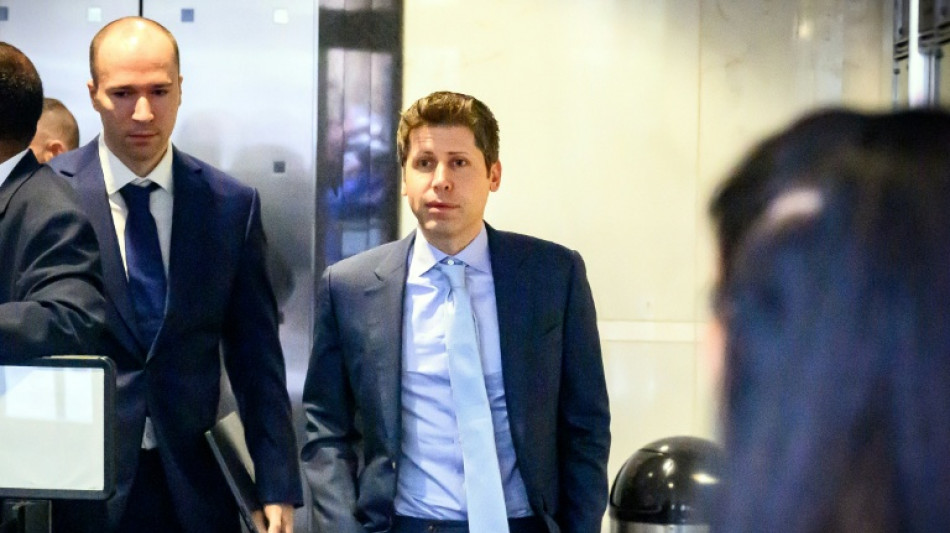
Elon Musk was obsessed with trying to control OpenAI, the artificial intelligence company's CEO Sam Altman said Tuesday at a blockbuster trial pitting some of the world's wealthiest tech titans against each other.
Altman is the latest in a parade of Silicon Valley megastars to take the stand in the case brought by Musk over OpenAI's pivot away from scrappy non-profit into the $850 billion juggernaut behind ChatGPT.
Musk -- the richest person on the planet -- claims Altman and co-founder Greg Brockman improperly used a $38 million injection he had hoped would sustain OpenAI as a research lab, developing the technology for the good of humanity.
"It does not fit with my conception of the words 'stealing a charity' to look at what has actually happened here," Altman told the court in Oakland, California.
OpenAI was founded as a non-profit in 2015, but established a for-profit subsidiary in 2019 as the AI race heated up.
Altman and others insist this was necessary to raise the vast sums of money from investors, including Microsoft, required to compete in a costly and difficult field.
Musk's legal case demands that OpenAI revert to non-profit status, a move that would impact its position in the global artificial intelligence race against Anthropic, Google and China's Deepseek.
OpenAI counters that Musk -- who is now also an AI competitor with his xAI -- is motivated by petty revenge, having failed to seize majority control of the commercial entity.
The court has heard how, in 2017, the company's co-founders discussed the creation of the subsidiary with Musk.
Altman said Tuesday that the Tesla boss demanded a huge controlling stake.
"An early number that Mr Musk threw out was that he should have 90 percent of the equity to start," he told the jury.
"It then softened, but it always was a majority."
"The fact that Mr Musk was unwilling to commit in writing to something contractual where he would not have long-term control made me very uncomfortable," said Altman.
He noted OpenAI had been founded with the belief that no one person should control artificial general intelligence (AGI), the hypothetical level at which AI is smarter than humans.
When Altman and Brockman thwarted Musk's attempts to dominate the company, the mercurial businessman walked away entirely, telling them the venture would fail without him.
"The thing that burned into my memory is when he told us we had a zero percent -- not one percent -- chance of success," Altman told the hearing.
- Money -
Musk's lawyers hit back, sparring with Altman over claims he is deceitful.
"Are you completely trustworthy?" Attorney Steven Molo asked. "Do you always tell the truth?"
"I believe I'm a truthful person," a tense Altman replied.
"It wasn't my question, sir," snapped Molo.
Altman was abruptly ousted as head of OpenAI in November 2023, accused of mendacity by his own board of directors.
He was reinstated five days later after a company revolt, but has struggled to shrug off a reputation for dishonesty in Silicon Valley.
Musk's case has highlighted the mind-boggling sums of cash washing around AI companies as they forge ahead with a technology that is changing the way we live and work.
That includes the $30 billion stake that Altman's co-founder Greg Brockman was revealed to have in the company.
On Monday, Microsoft CEO Satya Nadella testified that he was "very proud" of his firm's canny investment in the commercial venture, which has seen an initial $13 billion become worth more than ten times that amount in just a few years.
Altman's testimony is expected to continue into Wednesday.
An advisory jury is expected to reach a verdict on any actual wrongdoing by the week of May 18.
Judge Yvonne Gonzalez Rogers will then make the final ruling on both liability and remedies after hearing the jury's opinion. She has indicated she will likely follow their advice.
袁-J.Pān--THT-士蔑報