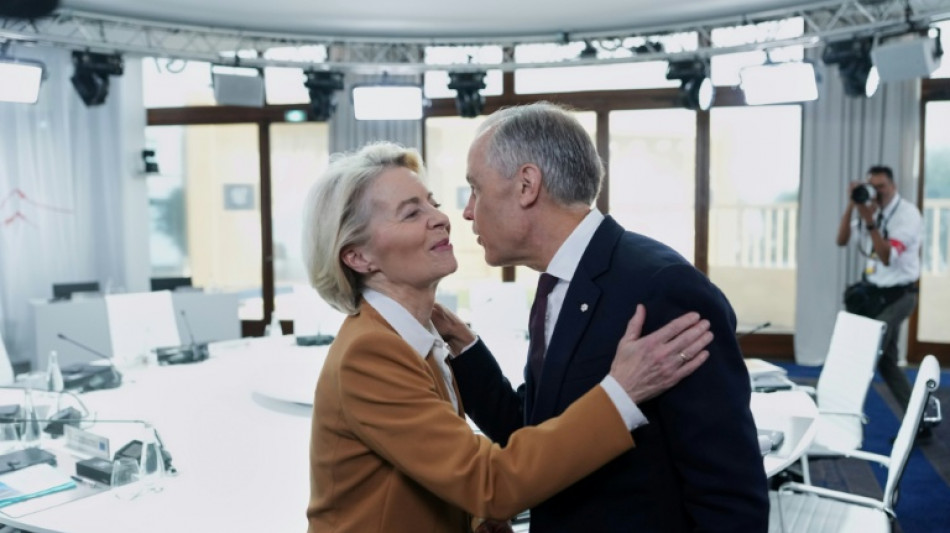
Canada's Carney seeks closer Europe ties to counter hostile US / Photo: Thibault Camus - POOL/AFP

Prime Minister Mark Carney calls Canada "the most European of non-European countries," and while formal EU membership may be tricky, he is pursuing unprecedented closeness with the bloc to reduce dependence on a hostile United States.
Carney heads to Strasbourg, France, this week, where he will become the first head of government to attend the "State of the European Union" address on Wednesday, before delivering his own speech at the European Parliament the following day.
He will also make a stop in Liverpool, where he will hold his first meeting with Britain's new prime minister, Andy Burnham.
His visit is a "tremendous symbol," said Tobias Cremer, a European lawmaker from Germany and the main sponsor of a March resolution calling for stronger EU-Canada cooperation.
"Canada has many of the resources that Europe is very much short of, whether it's in terms of energy, whether it's rare earths (and) raw minerals," Cremer told AFP.
Canada has been hit hard by US President Donald Trump's trade war given its close economic integration with its southern neighbor, and is urgently seeking new economic partners.
The EU has also been shaken by Trump's return to office and, like Canada, is seeking to "diversify and de-risk" its foreign relations, Cremer said.
- Future EU member? -
Carney has already brought Canada closer to the bloc.
Canada became the first non-EU country to join its defence procurement program, and the prime minister was involved in Canada joining the pop culture extravaganza Eurovision.
Next month, Carney is hosting an EU-Canada summit in Montreal, where he said discussions will begin on building "a much stronger and deeper economic and security partnership."
Javier Moreno Sanchez, a Spanish EU lawmaker who heads a parliamentary delegation for relations with Canada, noted that Ottawa and Brussels see eye-to-eye on climate and AI, and a digital trade deal is already in the works.
That pact would build on an existing free trade agreement called CETA, which Sanchez said has unrealized potential as small and medium-sized firms are not yet taking advantage of its benefits.
Speculation about full EU membership for Canada has intensified during Trump's second term.
Carney was asked Thursday about the prospect of Canada joining the EU and delivered what he termed a "non-answer," declining to rule out the idea or endorse it.
- Not 'realistic' -
An April poll showed 57 percent of Canadians backed EU membership, but it's not clear whether Canada is even eligible.
Article 49 of the EU treaty states that "a European state" committed to "human dignity, freedom, democracy, equality and the rule of law (and) respect for human rights" can join the bloc.
The treaty does not specify the geographical criteria of a European state, but it's hard to imagine Canada qualifies.
"The idea of Canada becoming a member of the European Union, either on economic or political terms -- I don't really see that this is a realistic prospect," said Ignacio Garcia Bercero, an analyst at the Brussels think tank Bruegel.
In 1987, Morocco was denied membership on grounds that it was not a European state.
Sanchez joked that Canada "wasn't that far" geographically overall, given its proximity to the Danish autonomous territory of Greenland.
But close ties with the EU are possible without full membership, as is the case for Iceland and Switzerland, he said.
But unlike with Switzerland, shipping goods between Canada and the EU comes with substantial transport costs and Europe will never replace the American market for Canada.
In July, 70 percent of Canadian exports went to the US, compared with just five percent to the EU.
Still, "the closer we can cooperate, the better," Cremer said.
彭-C.Péng--THT-士蔑報