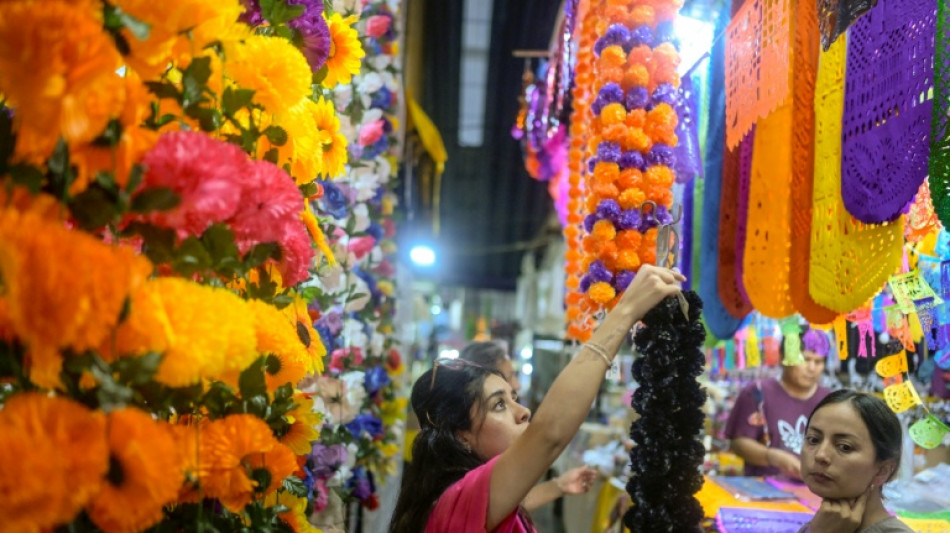
In the Mexican town that makes emblematic Day of the Dead garlands / Photo: Alfredo ESTRELLA - AFP

In a workshop in the Mexican town of San Salvador Huixcolotla, three men use small hammers and chisels to punch holes in thick sheets of tissue paper ahead of the Dia de Muertos (Day of the Dead) festival.
The multicolored paper perforated with intricate folk art designs is known as "papel picado" (pecked paper).
It is a central element in the lavish altars erected to the deceased on November 1-2 and is also used to festoon homes and streets.
Papel picado originated in this small central Mexican town in the late 19th century.
More than a century later, three-quarters of the town's 17,000 inhabitants are employed in producing the paper, which is exported worldwide.
Despite the advent of AI and 3D printing, many people here continue making the paper by hand.
"We get satisfaction from the idea that our craftsmanship is recognized in other countries and that people see value in handmade things," Miguel Reynoso, a 58-year-old papel picado producer, told AFP.
Reynoso has been in the business for 40 years.
He and his wife employ over a dozen people, including their four daughters, making decorative banners for clients as far away as South Korea and Japan.
The garlands are in demand year-round for events such as baptisms and "quinceaneras" (girls' 15th birthdays, a major milestone in Latin America).
But orders skyrocket in the lead-up to the Day of the Dead, when hundreds of thousands of sheets of paper are used to deck out towns and cities.
- 'My tradition' -
The art of making papel picado was born on ranches outside Huixcolotla.
Following a Mesoamerican tradition, farm workers used to etch simple geometric designs into thick paper made from tree bark.
The arrival of fine tissue paper from China in the mid-19th century revolutionized the process, allowing for greater sophistication.
Nowadays, the paper too is manufactured in Huixcolotla, which prides itself on controlling the entire process.
Even the chisels -- straight, curved or zigzag, depending on the motif -- are made here.
The palette of colors used in the paper has evolved over time to include shades associated with Mexican design, such as lime and Mexican pink (fuchsia).
Roberto Carlos carefully carves a skull adorned with an elegant hat into a wad of deep purple paper 50 sheets deep.
If the paper tears, he has to discard the lot, which is why you have to "be very delicate," the 34-year-old artisan explained.
Mari Reynoso, Miguel's 26-year-old daughter, acknowledged that "industrialization" threatened her town's bread and butter.
The disappearance of handicrafts, "a symbol of Mexico," would be a blow to the country's heritage, she argued.
"Just seeing them makes people say: 'This is culture, this is my tradition.'"
萬-M.Wàn--THT-士蔑報