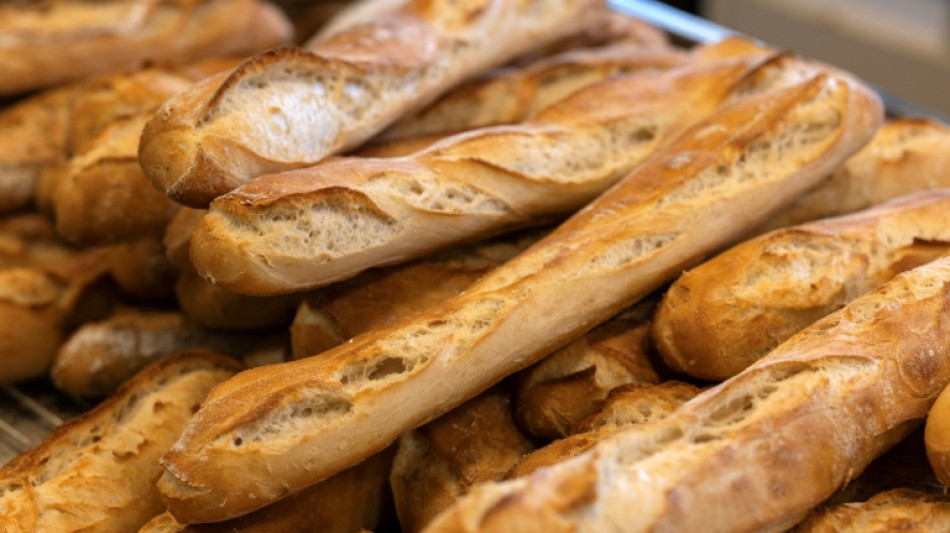
No cadmium please: French want less toxin in their baguettes / Photo: Fred TANNEAU - AFP

France is mulling how to prevent people from ingesting too much of the heavy metal cadmium, after a warning their breakfast cereal and baguettes could be contaminated with the toxin.
Here is what to know.
- What is cadmium? -
Cadmium is a chemical element naturally found in the ground at low levels, particularly in limestone-rich areas.
But the concentration of the carcinogenic element can increase through deposits, including phosphate fertilisers used to grow crops that then end up on people's plates.
- What's the problem? -
Nearly half of the French population last year had cadmium exposure levels exceeding reference values, France's National Agency for Health Security (ANSES) warned in March.
It noted "worrying cadmium contamination at all ages, starting from a very young age".
For non-smokers, this came primarily from consuming contaminated food including breakfast cereals, bread, croissants and other pastries, biscuits, rice and potatoes, it said.
- How bad is it? -
French doctors last year begged the authorities to act, saying women and children were especially being contaminated and blaming "phosphate fertilisers containing too much cadmium".
France's top health authority in 2024 warned that "repeated exposure to low doses can be the cause of multiple health effects: on the kidneys, bones, respiratory system, nervous system, cardiovascular system, reproduction, and it can be carcinogenic".
When it is inhaled, through smoking or in industrial settings, it can cause lung cancer, according to the World Health Organization.
Ingesting too much of the toxin may also cause cancers of the kidney and prostate, it says.
- What can be done? -
France is mulling two ways to help: testing people to get a better measure of how widespread contamination is, and regulating fertilisers to limit new cadmium entering soils.
As a first step, France is soon to introduce a reimbursable test for people living in higher-risk areas, the health minister's office has said.
The health authority has recommended the test, to be introduced this summer, for people living in limestone-rich regions or near some 7,000 old industrial sites.
But doctors could also recommend it outside these regions, the ministry said.
Francois Blanchecotte, president of France's Federation of Medical Laboratories, said the urine test -- and possibly blood test -- would be able to determine if someone suffered from a "significant chronic intoxication".
"Something really had to be done: cadmium builds up silently in the body and can ultimately cause serious problems," he said.
Toxicologist Robert Garnier said reducing exposure was key as there was no medication to help eliminate it from the body.
"The top priority is to reduce young children's exposure: not because there are risks for them today, but because they will eventually grow old," he said.
"Even the cadmium accumulated in childhood will not have been completely eliminated by the time they are over 60," he added.
- What about fertilisers? -
France's cadmium rate in earth of 0.25 mg/kg is only slightly higher than the EU average of 0.20, according to a 2024 study of topsoils in the bloc.
But some consumers are worried, with several petitions popping up online in recent months demanding the government take measures.
The ANSES health security agency has recommended lowering the maximum permitted cadmium levels in phosphate fertilisers from the current 90 mg/kg in France to 20 mg/kg.
Up to 60 mg/kg is allowed in these fertilisers in the European Union.
A bill, to be discussed in parliament next month, wants to cap allowed cadmium levels in fertiliser to 40 mg/kg by next year and 20 mg/kg by 2030.
The National Research Institute for Agriculture, Food and the Environment has also recommended "limiting the use of synthetic fertilisers", which it says are already down by 70 percent compared to the 1980s.
It has also suggested farmers select wheat varieties for pasta and bread that are "less prone to accumulating cadmium".
Doctors have urged the government to help boost organic food consumption, especially in schools.
burs-ah/pdw
劉-T.Liú--THT-士蔑報