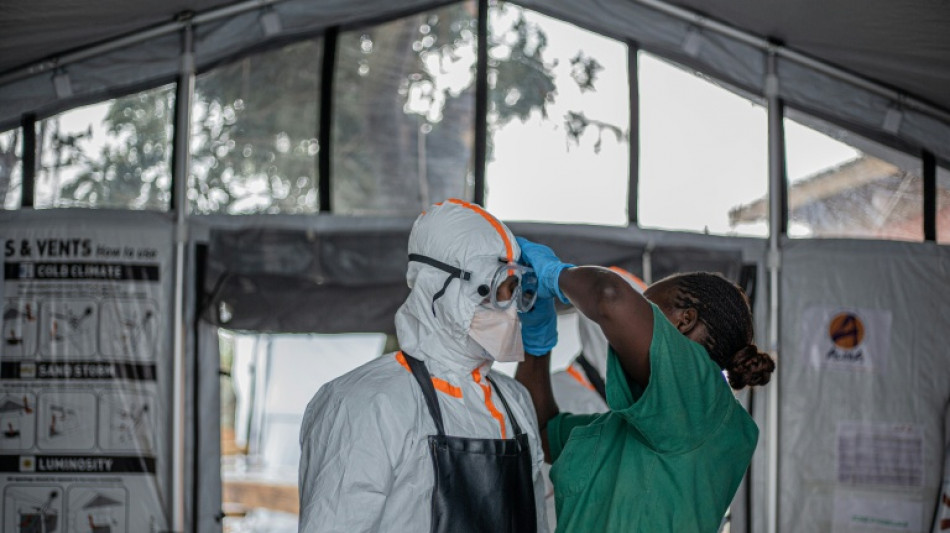
WHO chief urges stronger Ebola response in DR Congo visit / Photo: BENEDICTION MURHABAZI - AFP

The head of the World Health Organization on Wednesday urged authorities to step up the Ebola response and better protect frontline health workers, during a visit to the DR Congo where a deadly outbreak is spreading fast.
The Democratic Republic of Congo declared its 17th Ebola outbreak on May 15.
There have been 3,874 confirmed cases including 1,751 deaths in the DRC in the outbreak, according to figures published by the WHO.
WHO director-general Tedros Adhanom Ghebreyesus arrived in Kinshasa on Tuesday, and was set to meet President Felix Tshisekedi, a spokesman told AFP on Wednesday, without giving further details.
"The outbreak is spreading faster than our scale-up of the response, with new cases doubling in some hotspots over the past week alone," Tedros wrote on X, after meeting organisations involved in the response effort.
"We must urgently and massively scale up all our efforts.
"That means reaching every affected community despite insecurity and displacement, strengthening coordination... ensuring health workers have the protection, training and support they need, and accelerating access to care, surveillance and safe, dignified burials."
- US funding boost -
The United States announced Wednesday that it had allocated more than $242 million in additional funding to combat the worsening outbreak.
The new funding brings direct US financial assistance in response to the outbreak to more than $500 million, the State Department said, underlining that the United States remained "the largest financial contributor to the Ebola response".
Tedros was previously in the DRC at the end of May in the northeastern province of Ituri, where nearly 90 percent of Ebola cases have been identified.
The five affected provinces in eastern DRC have a weak state presence and healthcare infrastructure is largely lacking.
The struggle to contain the outbreak was laid bare this week in the Ituri mining town of Mongbwalu, where staff at an Ebola treatment centre protested over unpaid government allowances before being dispersed by police warning shots, according to hospital sources.
On Tuesday, a new 100-bed Ebola treatment centre opened in Ituri's capital Bunia, to help address the growing number of patients, the UN aid agency OCHA said.
Ebola is spread by contact with bodily fluids and causes a haemorrhagic fever. It has killed more than 15,000 people in Africa in the last 50 years.
- Vaccines and treatments -
The current outbreak has been caused by the Bundibugyo species of the virus, for which there is currently no approved vaccine or treatment.
On Tuesday, Canada gave the go-ahead to US pharmaceutical giant Moderna to begin clinical trials of a candidate vaccine against Bundibugyo.
In late July, a volunteer received the first dose of another potential vaccine against Bundibugyo, developed by Britain's Oxford University using the same technology as the AstraZeneca Covid-19 vaccine.
And Singapore-based Hilleman Laboratories is working on bringing a third potential Bundibugyo jab to human trials.
The WHO sees it as the "most promising" because it uses the same rVSV platform as the only officially licenced Ebola vaccine Ervebo, which targets a different strain called Zaire.
Two potential treatments are being tested on confirmed Ebola patients in Ituri: the monoclonal antibody MBP134 and the antiviral drug remdesivir, alone and in combination.
Meanwhile a trial is also taking place in Ituri of the oral antiviral drug obeldesivir, for people exposed to confirmed Bundibugyo cases.
馮-X.Féng--THT-士蔑報