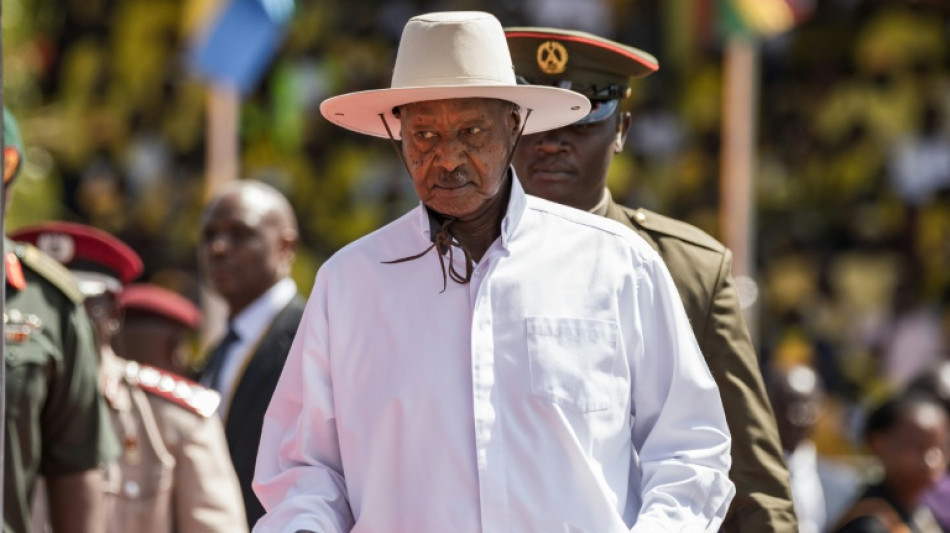
Uganda names its oil 'Pearl Sweet' as it prepares for first exports / Photo: BADRU KATUMBA - AFP

Uganda officially named its oil "Pearl Sweet" on Wednesday as its energy secretary said it expects to join the club of oil-exporting nations by the end of the year.
Two oil sites in western Uganda, run by French energy giant TotalEnergies and the China National Offshore Oil Corporation, are close to completion and will eventually give the east African country a peak production capacity of 230,000 barrels per day.
Energy secretary Irene Batebe told AFP the first site, Kingfisher, would come online "by the end of this year" with an initial production of 28,000 bpd.
The much larger Tilenga site is 74 percent complete, she added.
"The petroleum will push us very far," President Yoweri Museveni, 81, said at the "oil-naming ceremony" in Hoima district, where a 60,000-barrel-per-day refinery is also being constructed.
The name "Pearl Sweet" is a reference to Uganda's nickname as the "pearl of Africa" and the oil's low sulphur content.
Most of the oil will be pumped out of landlocked Uganda along the newly constructed East African Crude Oil Pipeline (EACOP), the world's longest heated pipeline, stretching 1,443 kilometres (897 miles), to the Tanzanian coast.
"We expect combined EACOP and Kingfisher to enter production by the end of this year as we work to bring Tilenga on board," Batebe said.
Uganda's oil is particularly viscous and must be kept at 50C to be transported through the pipeline.
The project has been controversial: described as a "carbon bomb" that will unleash 379 million tonnes of climate-heating pollution over its lifetime.
Around 100 wells are located in Uganda's largest and oldest national park, Murchison Falls, and there are fears of leaks from the pipeline that crosses fragile and highly biodiverse ecosystems and wildlife migration routes.
More than 100,000 people have been displaced, with many criticising limited transparency and insufficient or slow compensation, according to NGOs.
TotalEnergies says "strict measures have been taken to avoid, mitigate and offset" the impact on local environments and that it has compensated 99 percent of displaced households.
何-H.Hé--THT-士蔑報