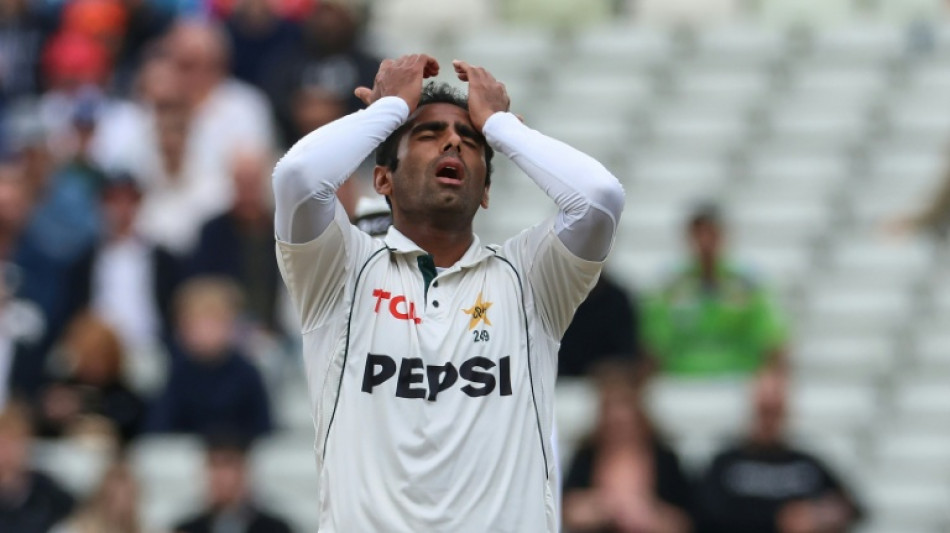
Crash and burn: Pakistan cricket at a new low after England humiliation / Photo: Darren Staples - AFP

Pakistan cricket hit a fresh low during the dismal 3-0 Test whitewash in England, even if a dazzling cameo by debutant Razaullah at least ensured a tour marred by mid-series sackings ended with a flicker of hope.
Described as the worst team to tour England in the last 50 years, Pakistan's cycle of chopping and changing continued when head coach Sarfaraz Ahmed and bowling chief Umar Gul were sacked from their posts.
Seven players were expelled from the squad as the often vulnerable batting fell to a new low, failing to cross 200 in five of the six innings.
White-ball coach Mike Hesson was brought in to take charge of the side for the third and final Test, a move which failed to reverse Pakistan's fortunes.
The turmoil intensified when expelled players Mohammad Rizwan and Imam-ul-Haq were investigated by the national cybercrime agency on charges of leaking team information.
Former Pakistan captain Wasim Akram said he had predicted this free fall.
"It's a disappointing state but I could see this coming for the last five years and you can't blame one particular person and one factor because there are many," Akram told AFP.
His fellow former star Shahid Afridi described the situation as "bleak".
"These are gloomy times in Pakistan cricket," Afridi told AFP. "You don't disrespect players like this and your system is not strong."
Changes and upheaval after defeats are hardly new for Pakistan. The cricket team has had three captains and six head coaches for Tests over the last three years.
The Pakistan Cricket Board (PCB) has also had five different chairmen in as many years, resulting in a lack of consistent planning that has hurt the game's development.
Punishing players has often gone hand in hand with those changes.
The PCB banned then-captain Mohammad Yousuf and senior batter Younis Khan for an indefinite period and disciplined five other players, including Afridi, after a disastrous 3-0 whitewash in Australia in 2010.
The third-test defeat to England at Edgbaston was Pakistan's 16th in their last 21 Tests, leaving them ninth and last on the World Test Championship (WTC) table, the same position in which they finished the previous cycle.
Results in white-ball cricket have not been encouraging either.
Pakistan crashed out in the first round of the ODI Champions Trophy last year, even though the event had marked the revival of their hosting rights after a 29-year exile caused by security concerns.
Their Twenty20 fortunes have also gone into free fall.
Pakistan failed to reach the semi-finals of the 2026 T20 World Cup, while another campaign two years earlier ended in an embarrassing group-stage exit that included a shock defeat against an unfancied USA side.
Former leg-spinner and 1992 World Cup winner Mushtaq Ahmed blamed the decline on a lack of planning.
"We had a great number of match-winners and a strong legacy, and that is why we produced results in the past," Ahmed told AFP. "Now the decline is steep and will take time to fix."
With a flawed and inconsistent domestic system failing to prepare players for the demands of international cricket, an immediate solution appears unlikely.
"We need to realise that we lack talent in red-ball cricket. White-ball teams are okay," said Akram. "It's easy to blame the PCB chairman but when we were sleeping and not addressing the overall flaws then such a fall happens."
Meanwhile, fans are fast losing interest.
"All my four sons and I used to play in a local academy but in the last two years we all have lost interest as our team is not doing well," said Mohammad Afzal, a banker.
"Cricket is fast losing ground in Pakistan and we need strong measures to revive the glory."
喬-H.Qiáo--THT-士蔑報