'A very big deal': Canadian astronaut reflects on historic Moon mission / Photo: Charlotte CAUSIT - AFP

As soon as Wednesday, NASA is poised to make history -- sending the first woman, the first person of color, and the first non-American on a voyage around the Moon.
Canadian Jeremy Hansen is among the four-person crew, what astronaut and fellow countryman Joshua Kutryk called "a very big deal."
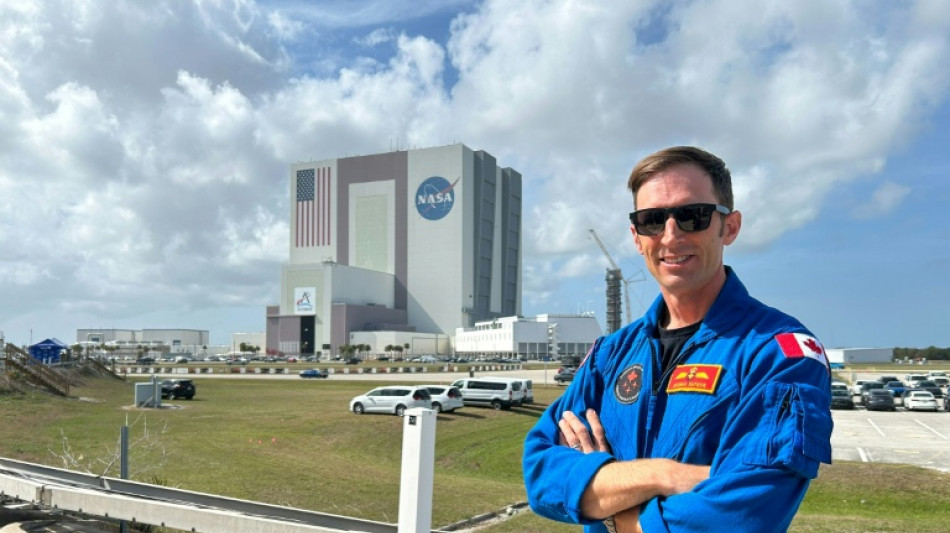
Wearing a traditional royal-blue flight suit, Kutryk -- who is currently training for his own mission to the International Space Station -- made the trip to Florida's Kennedy Space Center to cheer on his colleague, who could take off as early as April 1.
In an interview with AFP, Kutryk discusses the significance of this new chapter of American space exploration:
- How do you feel ahead of this mission? -
It is a huge deal. It's the first -- not just the first Canadian lunar mission -- it's the first mission in the world that isn't purely a US crew.
So, it's a very big deal in Canada. I feel very excited, very proud.
Jeremy is a great friend and a great astronaut and a great ambassador to Canada, and I'm just excited to see him go do this.
- Why does this launch matter for Canadians? -
It's not a coincidence that Canada was invited to participate in this mission. It's because of what we've done in Canada that is valued by NASA, and that's something that makes me excited, but even more so proud to be from Canada right now.
Canada has been partnered with the United States throughout most of human space exploration. We started back with the Space Shuttle Program. We had astronauts flying in the 80s... We helped to construct the space station. We designed and built the suite of robotic systems that still operates a space station, even as you and I speak today.
Particularly with Artemis though, we were the first country to join the United States in this vision of going back to the Moon.
Now there are many countries in the Artemis Accords -- Canada was the first. And we contribute, or rather, we committed to contributing technology to help these missions take place.
And we've committed to developing robotics technology, to developing lunar rovers that are going to help explore the surface.
- Why should we return to the Moon? -
There's a lot of things in the world right now -- more than enough -- to leave people, myself included, feeling pessimistic about things.
This leaves me optimistic... it shows us that we can still do this stuff, the really hard stuff.
We can still do it together -- Canada, working with the United States, international cooperation -- and we haven't backed down from doing the really hard, next to impossible things, which are going back to the Moon.
That's really cool as an astronaut, to think that I have a friend who's going to go around the far side of the Moon.
But it's more than just cool. It's important for us. It's important for societies. It's important for Canada. It's important for our future, because this is how we get better.
It's how we advance and develop new technologies, make new scientific discoveries that chart a better course for us going forward.
And so for me, space is opportunity, and missions like this make me optimistic.
- What's different about the Artemis mission? -
What we're trying to do, technology wise, is very different.
The Apollo program was designed to send small crews there for short periods of time and bring them back, and not really to do anything there.
The whole mission with Artemis is sustained, permanent exploration and presence.
If you think about what we do in low Earth orbit now, we have humans working from all over the world together for long periods -- six, seven, eight, 12 months at a time -- that's what I'm getting ready to go do.
We want to do that on the surface of the Moon. That's what Artemis is about, and that's something that we couldn't have done during Apollo because we didn't have the technology to do it.
Another difference that I think is worth pointing out is that Apollo was just the United States, for good reasons at the time.
But Artemis is entire collaboration of dozens of countries from around the world -- and it's an important difference from that point of view.
文-L.Wén--THT-士蔑報