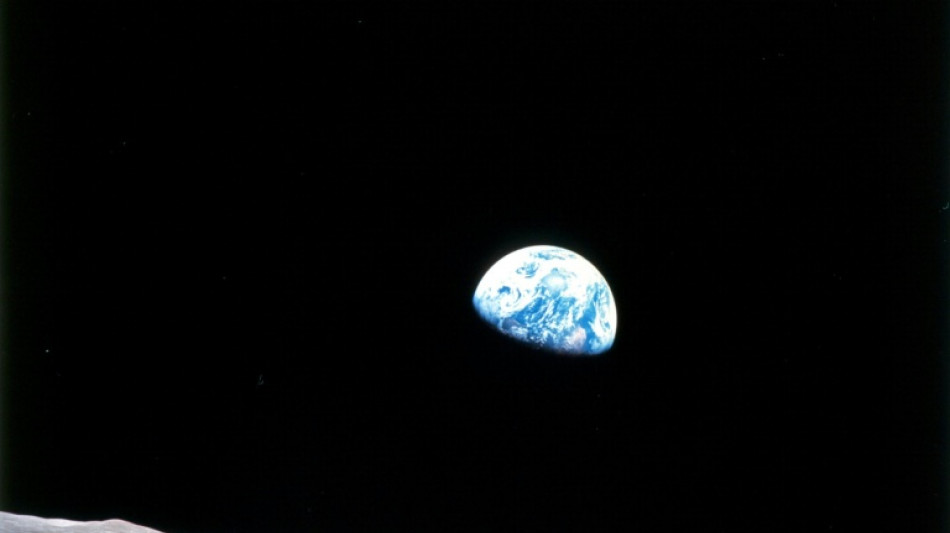
Artemis II crew basks in glow of lunar flyby en route to Earth / Photo: Handout - NASA/AFP/File

The Artemis II astronauts were jetting towards Earth and sharing their lunar flyby souvenirs Tuesday, delighting colleagues both at home and in space with tales of their historic journey.
Of note was their stunning shot of an Earthset, the moment when Earth drops below the rugged lunar horizon.
The image was a deliberate nod to the iconic Earthrise image taken by an Apollo 8 astronaut in 1968, a shot that helped capture the public's imagination during the first space mission to carry humans around the Moon.
The modern version released by NASA pairs the delicate, watery planet Earth with the harsh curve of the Moon, separated by black space.
"First photo from the far side of the Moon," the White House said, reposting the image.
The astronauts were busy Tuesday afternoon debriefing lunar scientists in Houston's mission control about what they had witnessed during their nearly seven-hour lunar observation period.
"Our whole Lunar Science team and the broader science community have been pouring out positive feedback and gratitude, so know that what you did yesterday really made a difference scientifically," said Kelsey Young, lead scientist for the Artemis II mission.
The crew of four -- US astronauts Reid Wiseman, Christina Koch, and Victor Glover, teamed with Canadian Jeremy Hansen -- went on the mission to loop around Earth's natural satellite as part of a broader program paving the way for a Moon landing in 2028.
After completing their lunar flyby -- in which they also broke the record for distance from Earth -- they were bound for home, with splashdown due in the Pacific off the California coast late Friday.
In the meantime they took a call from colleagues in space -- chatting with crewmembers aboard the International Space Station.
"It's fun to be up in space with you at the same time!" said Canadian astronaut and Artemis II crewmember Jeremy Hansen.
- 'Hard to describe' -
The crew have reported in vivid detail features of the lunar surface and later witnessed a solar eclipse, when the Moon passed in front of the Sun.
They also described flashes of light -- meteor strikes -- on the Moon's surface.
"Humans probably have not evolved to see what we're seeing," said Victor Glover. "It is truly hard to describe. It is amazing."
Late Monday, the crew got a congratulatory call from NASA administrator Jared Isaacman and US President Donald Trump, who at 79 is old enough to remember the Apollo program.
He was, in a word, impressed.
"You've really inspired the entire world," Trump said, calling them "modern-day pioneers" who have "a lot of courage."
He probed the astronauts about their favorite moments and asked what it was like to lose connection with Earth for some 40 minutes during an expected communications blackout.
The call even had a little signal glitch of its own, with Trump waiting expectantly as the astronauts appeared not to hear him for a full minute.
"Might have gotten cut off," Trump said afterwards. "It is a long distance."
- Historic trip -
The Artemis II team broke the distance record set by the 1970 Apollo 13 mission, which they surpassed by more than 4,000 miles (more than 6,000 kilometers) when they reached the journey's furthest distance from Earth 252,756 miles (406,771 kilometers).
Astronaut Jeremy Hansen said the moment should "challenge this generation and the next, to make sure this record is not long-lived."
Glover was the first person of color to fly around the Moon, Koch was the first woman, and Canadian Hansen the first non-American.
The Orion capsule carrying the astronauts is now traveling back to Earth in a so-called free-return trajectory, before it's set for an ocean splashdown.
張-H.Zhāng--THT-士蔑報