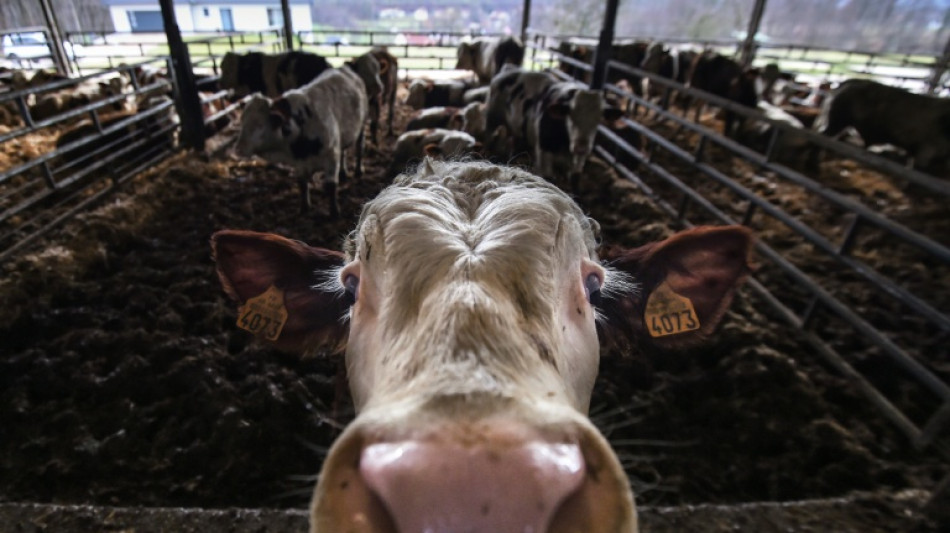
French farmers suffer arid crops, heat-stricken animals / Photo: Sebastien Bozon - AFP
France's current heatwave is taking a toll on farmers, who are seeing livestock die and are racing against time to harvest cereals without sparking fires in the tinder-dry crops.
Stephane Delapre, a farmer in Beauvoir-sur-Mer, near the western coast, said half his chickens had died of suffocation on Monday.
"In 42 years, I've never seen that," he told AFP as he waited for an official to collect the carcasses.
Depre raises around 17,500 free-range hens and 70,000 quails in sheds with outdoor runs.
"We put in a few fans but... it went up to 40–41C. There was nothing we could do," he said.
Sixty kilometres (40 miles) away, Regis Bonnin, 57, said he had set up misting systems to cool his 120 dairy cows, who were producing four to five litres less milk per day.
He had already lost a heifer with weak lungs and feared future reproductive problems.
He said he would hang on until next week to cut his wheat, for fear the combine harvester would spark a fire in the parched crop.
Neighbours had "already put out two blazes".
His main crop worry was his maize yield.
"If it flowers when temperatures are above 30C the pollen will be sterile," meaning the ears of corn will have fewer grains, he said glumly.
- Pressure cooker -
The heat also generates logistical headaches.
Sebastien Mery, who farms wheat and rapeseed in the Gatinais region, south of Paris, harvests early in the morning and late at night to avoid the worst of the heat.
But those timings mean he cannot get the cereal straight to a local silo because they are not open then.
Where regional authorities have banned harvesting between 2:00 pm and 7:00 pm, some silos are now opening overnight.
Stephane Baron, from Charente-Maritime, western France, is bracing for disastrous harvests, due to downpours in February and successive heatwaves in May and June.
His soft wheat yield was half what was needed for the crop to be profitable, he said.
France's powerful intensive-farming union FNSEA said maize and sunflowers were likely to survive this year "with a bit of water" but wheat could be problematic.
"Sometimes the wheat's too dry, so the grain is too small and risks being thrown out with the straw" by the combine harvester, said Franck Laborde, FNSEA's head of climate risk.
The worst heatwave in most French farmers' memory was the disaster of 2003.
But that came in August, when crops were already three-quarters grown, Bonnin pointed out.
This time, the searing heat has come much earlier in the growing cycle.
"The difference now is we've got a succession of extreme events," said Inaki Garcia de Cortazar-Atauri of research institute INRAE.
"There's no magic formula against the pressure-cooker effect," he said, but stressed that environmental farming practices offer a "framework" for adaptation that can be developed "in every region and every sector".
許-X.Xǔ--THT-士蔑報