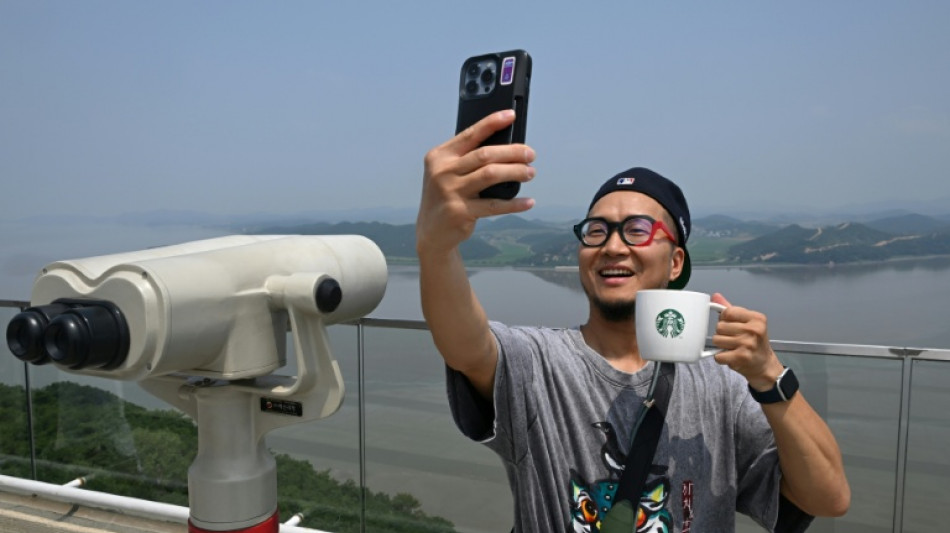
Coffee with a view: tourists flock to Starbucks overlooking North Korea / Photo: Jung Yeon-je - AFP
The contrast cannot be starker: selfie-taking tourists sipping coffee at Starbucks -- an icon of globalisation and capitalism -- while looking out over reclusive, communist North Korea.
Welcome to Aegibong Starbucks in Gimpo -- less than an hour's drive from South Korea's capital Seoul but a world away from its closed-off northern neighbour less than two kilometres (1.2 miles) across the Han river.
Perched on a hilltop beneath the Aegibong Peace Ecopark observatory where telescopes peek into the secluded state, the shop has drawn tens of thousands from South Korea and abroad since opening in November 2024.
Kim Jong-hyun, who lives in San Diego and was visiting South Korea with his family, said it was the irony of the contrast that drew him to the hilltop.
"When I heard there was a Starbucks here, I naturally thought I had to come and see it for myself. It's quite unusual," he told AFP.
Customers need to book ahead to enter the park that houses the coffee house.
They then travel from a parking lot in a shuttle operated by park authorities and cross a military checkpoint guarded by armed South Korean marines.
The journey is part of the experience -- walking the last stretch inside South Korea while looking out on agricultural and mountain landscapes in a country whose outside image the government under Kim Jong Un seeks to manage entirely.
Very few foreign journalists or tourists -- mainly from allies Russia and China -- can enter North Korea, and then under tightly controlled conditions.
South and North Korea are technically at war because their 1950-53 conflict ended in an armistice rather than a peace treaty.
The nations are separated by an ironically-named Demilitarised Zone.
The South, an important US security ally, rose from the ruins of war to become an advanced economy home to Samsung Electronics and other tech giants.
But the North -- ruled with an iron fist by a third-generation leader -- is crippled by sanctions over its pursuit of nuclear weapons.
- 'On a different scale' -
James Seymour, an Irish tourist, told AFP the scene from the lookout point was one of "polar opposites."
"We're from Belfast and we're kind of used to war... the Troubles and all that if you know what I mean," he said, referring to the sectarian conflict that gripped Northern Ireland in the late 20th century.
But standing near the border, sipping coffee from a global chain while looking at the North's nondescript low-rise buildings, was "on a different scale completely", he said.
"You couldn't get any more American than Starbucks and you couldn't get any further than America than, you know... North Korea."
The number of visitors to Aegibong Peace Ecopark has more than doubled since the Starbucks opened, according to figures provided by park management.
The number of foreign visitors last year rose 275 percent to 56,829 from a year earlier, with Chinese tourists accounting for the largest share, nearly a third.
Lee Chun-woo of the Gimpo Cultural Foundation, which oversees the park, told AFP the increase was "totally attributable to the Starbucks store".
- 'Death to Communism' -
Starbucks Korea said it chose the setting for the "scenic confluence of the Han and Imjin rivers" that offer visitors a "unique place to relax amid nature".
In a statement to AFP, it did not mention the proximity of the 136-square-metre (1,464 square foot) store to North Korea.
But Chung Yong-jin, chairman of the Shinsegae Group that operates Starbucks Korea under a licensing agreement, has been more vocal about the South's secretive neighbour.
In several Instagram posts -- all of which he has since deleted -- Chung used the phrase "Death to Communism" multiple times.
"Whenever North Korea fired missiles, investors pulled their money out," Chung said in a 2022 social media post explaining his comments.
He described himself as "a business owner and as a South Korean citizen who lives with the daily uncertainty of not knowing when a missile might strike" his country.
"To some people, Death to Communism is a political slogan. To me, it's reality," said Chung.
文-L.Wén--THT-士蔑報