Jerusalem Police Operation Uncovers Second Temple-Era Burial Cave

Officers searching a Silwan compound after deadly interfamily violence discovered a rock-cut burial cave that initial examination dates to Jerusalem’s Second Temple period.
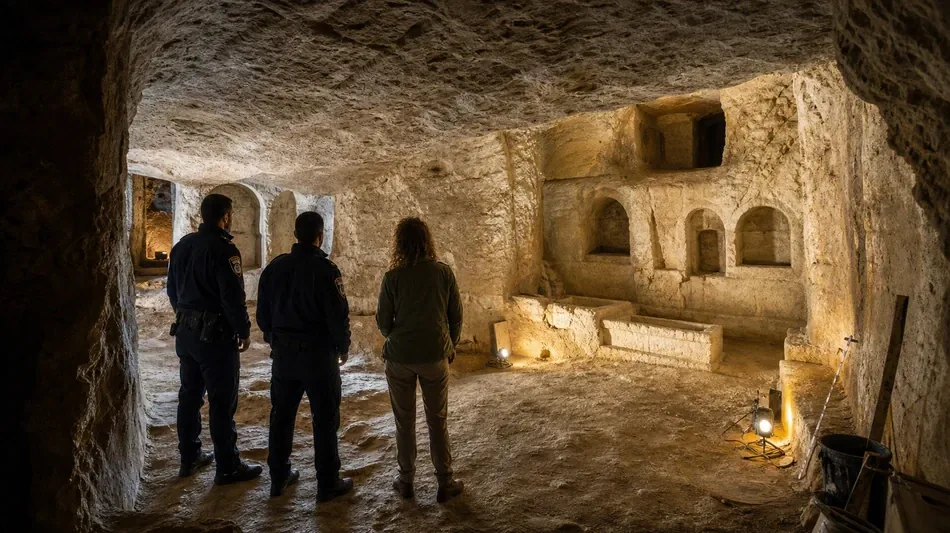
An Israeli police operation linked to violent conflict between families in East Jerusalem led officers to an ancient burial cave beneath a building in Silwan. The Israel Police announced the discovery on August 24 and said an initial examination by the Israel Antiquities Authority placed the graves in the Second Temple period.
Police entered the compound while searching for people connected to a deadly clash that reportedly included gunfire and Molotov cocktail attacks. Jerusalem Border Police officers also accompanied representatives of government authorities during searches at property where people involved in the confrontation were believed to live.
During that work, officers encountered the underground cave and additional archaeological material. Police secured the location so specialists could continue examining and handling the remains without interference. Officials did not provide a narrower date for the tombs or a detailed inventory of what was found.
Images released by police showed a dark, rock-cut chamber with debris across its floor. Caves of this kind were commonly used as family burial places in Jerusalem during the Second Temple era, which lasted from about 516 BC until 70 AD. The period ended when Roman forces destroyed the Second Temple during the First Jewish-Roman War.
The accidental find adds to a series of archaeological discoveries in Jerusalem, a city inhabited continuously for thousands of years. Earlier in the summer, authorities reported charred wooden beams dating back roughly 2,600 years that were considered likely remnants of the destruction of Solomon’s Temple.
Archaeologists also announced last year that they had uncovered the longest and best-preserved section of Jerusalem’s Hasmonean-era wall found to date. Such discoveries frequently emerge amid construction, infrastructure work or law-enforcement activity in areas where modern neighborhoods sit above ancient remains.
The Israel Police and Israel Antiquities Authority had not released additional findings at the time of the report. Further archaeological work will be required to establish the cave’s exact age, document its contents and determine whether the site contains evidence about the people originally buried there. Authorities were continuing to protect the location while specialists assessed the graves and associated finds.
莊-X.Zhuāng--THT-士蔑報